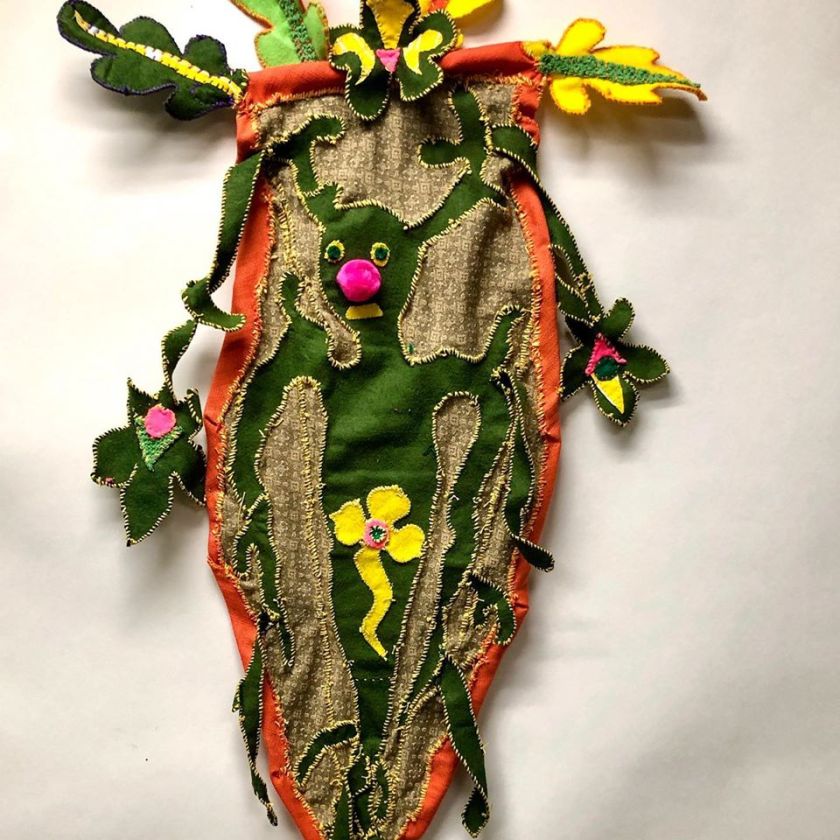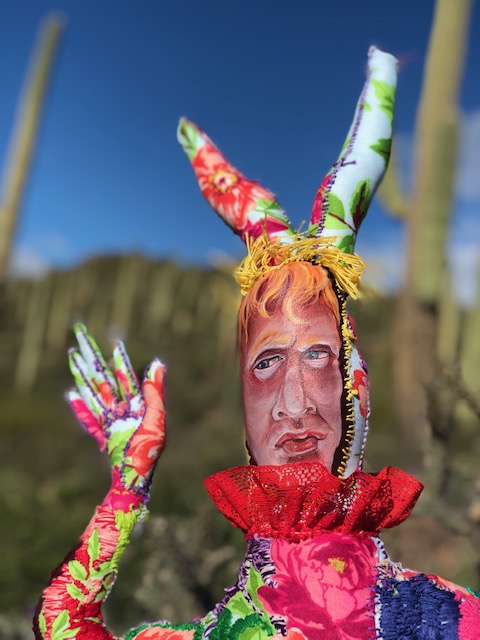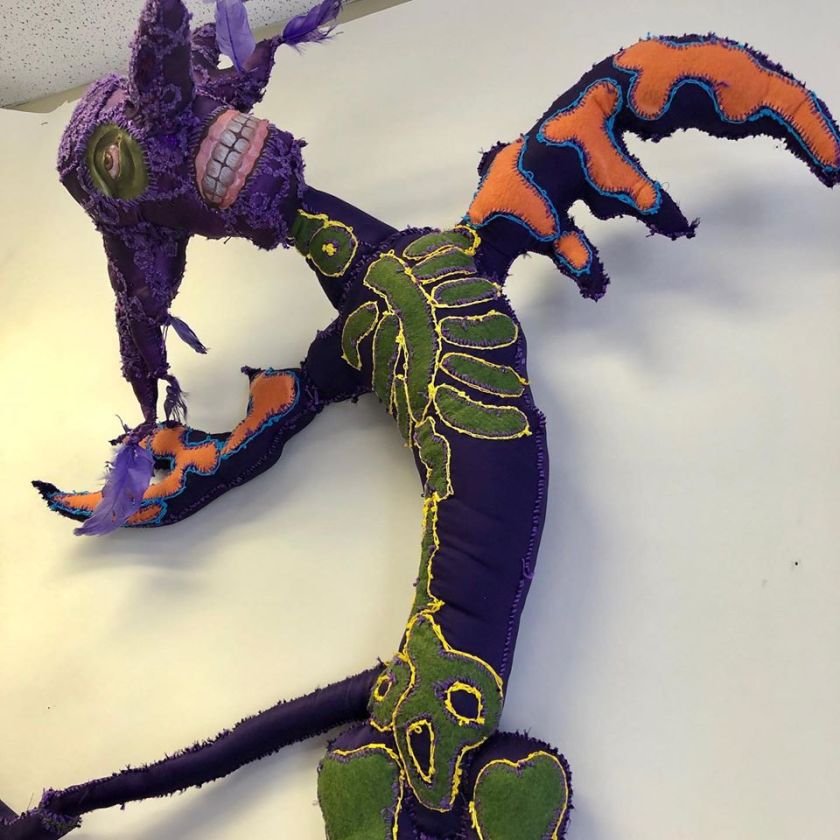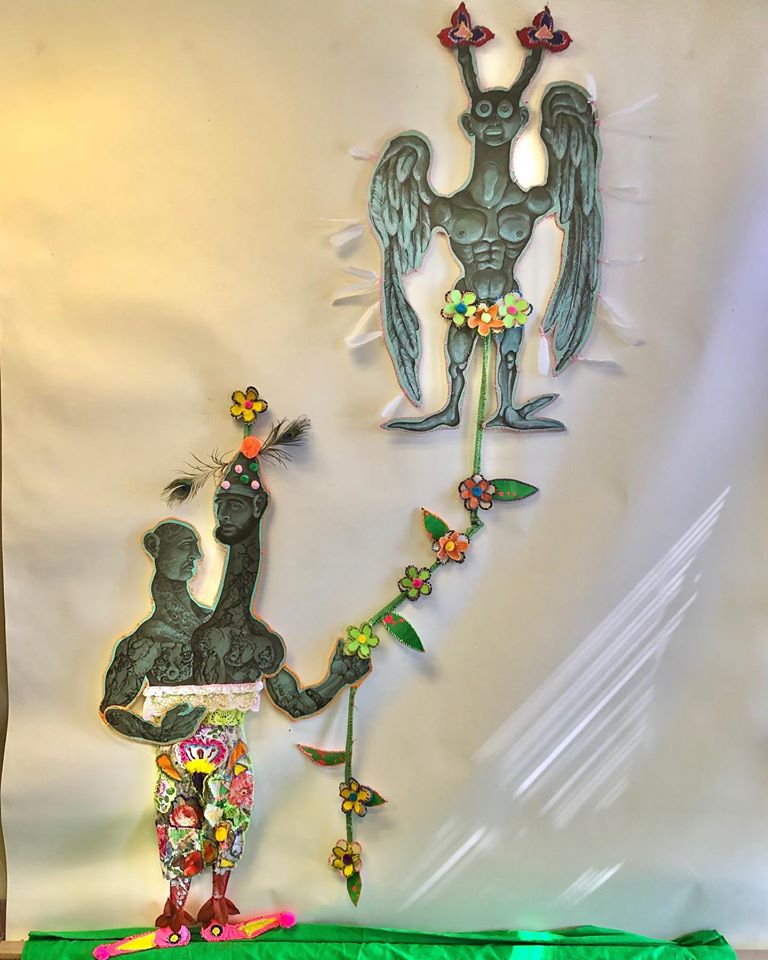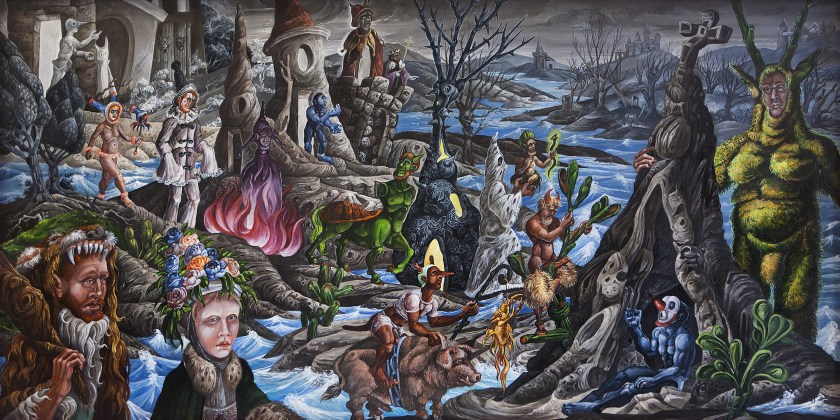
That darn anchorite keeps following me around, this time not so much in the desert but in a lush, abundant landscape inspired by the German Romantic painter Jakob Phillip Hackert (1737-1807).
The Temptations of St.Anthony of the Desert in an Italian Landscape (after Jakob Phillip Hackert, 1778) 2020 Oil on canvas 24 by 36 inches
It wasn’t really my intention to once again return to Anthony and his desert travails, at least not yet (currently more immersed in fairylands, bogles, goblins and pixiefolk). But in my studio, kicking about and frankly in the way, was a practice landscape from a few years back. I’ve long admired German Romanticism, particularly the dramatic treatment of nature, most especially trees. In the hands of a master like Hackert, trees are major players, singular beings rich in personality. I had hoped to better understand how these landscapes/tree-scapes were constructed so I set about copying one of my favorites, Hackert’s Italian Landscape, 1778.
My copy of Jakob Phillip Hackert’s “Italian Landscape”, 1778
It was a gratifying experience, in no way was I able to match Hackert’s luminous original, but I did learn valuable lessons in light, perspective and composition.
But then I had a painting that I wasn’t very interested in, wasn’t original, wouldn’t/couldn’t show, not particularly “good” and yet frankly too sentimentally attached to to just chuck.
So I decided to make it my own by reworking it in my own way. I’ve seen artists self consciously take thrift store paintings (rather annoyingly, seems a bit stunt-ish), works they mockingly called kitsch, and adapt them to their generally ironic purposes. This sort of practice is close to being a kitsch cliche in its own right but it started the wheels turning .
I’m not an ironic artist, nor did I think my painting kitsch, although granted a rather poor copy, but I was excited to reimagine Hackert’s poetic composition, eager to populate his pretty world with my imps and daemons. In many ways old master Jakob acted (unwittingly) as my collaborator. This latest painting the happy result.
Portrait of Jakob Phillip Hackert (1737-1807) by Augusto Nicodemo, 1797
I hope he would have been pleased.
As my composition is visually dense in the Boschian/Bruegelian sense, details follow:
DetailDetailDetailDetail of St.Anthony himself plus just a smattering of the gadfly temptations, oh, and his faithful pig.
This is the Master’s take, as you can see it is quite lovely, my copy so paltry in comparison. The wisest path was re-spinning my inferior version in my own voice.
Jakob Phillip Hackert Italian Landscape 1778The Temptations of St.Anthony of the Desert in an Italian Landscape (after Jakob Phillip Hackert, 1778) 2020 Oil on canvas 24 by 36 inches
In the end I am pleased, I made room in storage, profited from past labors and have a new painting I like quite a bit.
In 1769 the Royal Academy first set about creating a space for showcasing new works of art, two hundred fifty two consecutive years of discovering, exhibiting and promoting contemporary art to the public. The Summer Exhibition is the longest open call opportunity for artists of all rank to present their vision to the Academy and to the world.
That is quite an impressive feat.
Through the centuries this progressive mission became associated with an institution that might have seemed stodgy and which one rebelled against. I’m guessing all that has changed , I really do not know but for a boy growing up in New Jersey the tales of Varnishing Day, the glamour of opening day, the imagined pithy comments from Oscar Wilde, all created a siren’s call impossible to resist.
I’ve dreamt of submitting for years (decades) but hadn’t the nerve. I still lack the nerve but this year I submitted anyway. It wasn’t an overnight decision. At my solo show last year I met a British couple enthusiastic about my work, amidst their welcomed flattery they pulled out their phones and showed me glimpses of the Summer Exhibition 2018 fantastically curated by Grayson Perry, encouraging me to submit my work for they felt it would be right at home. It was exhilarating this thought, feeling so out of place in Los Angeles, adrift in where to next turn, it seemed a dream; this Royal Academy was FAR from stodgy, far from my conceived notions of what “academic” art was. This was a magical place of wild color, classical architecture, and wall after overcrowded wall of diverse and distinct art just begging for attention. I was floored. This was an oasis, far removed from the frequently tedious , muted, reserved, overly-curated, predictable gallery exhibitions found here in surprisingly conservative , tight-laced and conventional Los Angeles.
When we visited London for the first time last summer the RA Summer Exhibition 2019 was a must-see. I had already toyed with the notion of submitting after having seen glimpses of the Perry show but heading into solemnly magnificent Burlington House, situated in glamorous Piccadilly, in the very heart of London, then finding inside these impressive walls an abundance of art, art of all sorts, a staggering diversity of material, style and approach, all this sealed the deal.I was immediately convinced that I must at least try.
The long anticipated open call was announced this week on Monday. I was prepared and at the gate: all work freshly documented; a revised, suitably Anglophilic artist statement self-consciously composed; measurements and prices converted to metric and pounds. I was ALMOST confident. Nervously I typed in all the necessary information, exhibition submissions are always harrowing for me, but because this was so personally important it was especially so. But I soldiered on, all in order, all checked, double and triple checked, and then just when I attempted to pay the entry fee (entry fee is due before you can submit) I hit a wall, an unmovable glowing , unyielding wall on my laptop screen.
ERROR, error, error, unable to process. I tried again and again, rechecking triple checking every entry information, David checked, my publicist checked, we resubmitted, shut down, rebooted, cleared cookies and caches (whatever the heck they are), different browsers, computers, laptops, I-phones all to know avail. I contacted the RA support, they responded but the suggestions made proved unfruitful. I despaired, over-reacted, overwrought and self-pitying I was convinced I of course wasn’t worthy to even submit to the RA. I was such a loser they wouldn’t even take my money. In my pathetic state, eager to have them like me I became a Friend of the Academy…something I wanted to do anyway, but felt , hey, they’ll see I’m not some obnoxious self absorbed American. All absurd of course, it was some glitch, my rational brain knew this but I possessed such desire to just submit that I became quite abject in my disappointment and despair. It was resolved of course, my subsequent, pitiful emails were returned , a helpful assistant recognized the problem immediately and the Error message miraculously disappeared. With the error corrected (my fault of course) all was well, the submission window hadn’t suddenly closed in twenty four hours as I had ridiculously obsessed over, fees were paid, all was processed, entered, and the submit button nervously pressed.
The glitch? I had spelled out “California” instead of the required CA…damn California.
If I was irrationally anxious about the submission, I was irrationally proud of myself for actually having completed the task. The work that follows is what I, in the end , decided upon submitting. Perhaps not the wisest choices or most prudent, for they are large and unwieldy , and if the heavens allow and I am ,on the slimmest chance, shortlisted, the work will need to be seen up close and personal. This will be enormously expensive, but let me tend to that when and if it must be tended to. For now I will bask in the glow of an overly inflated sense of accomplishment.
I will receive first round results mid March …wish me luck.
Goblin Market 2017 Oil on canvas 122 by 152 by 5 cm 48 by 60 by 2 inchesGoblin Market, detailGoblin Market, detail
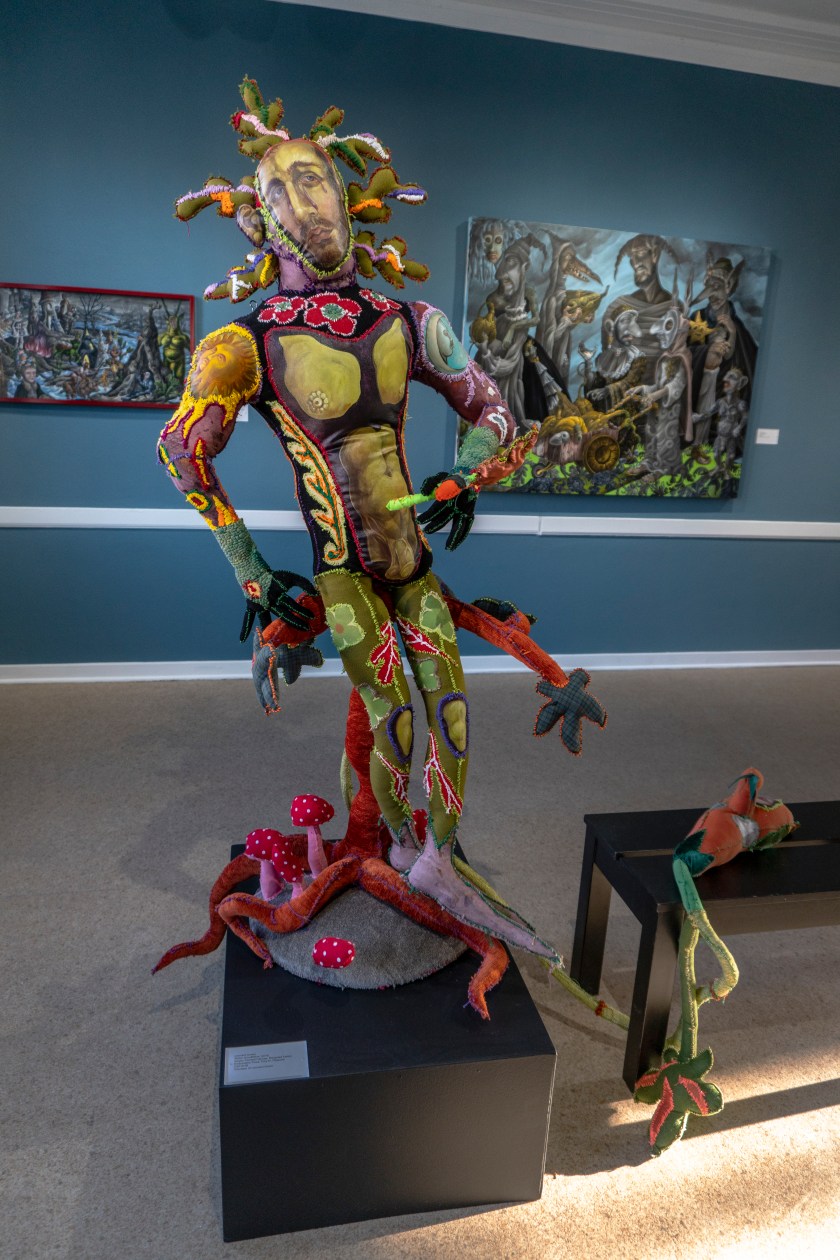
Robin Goodfellow 2018 Mixed media: acrylic painted canvas, recycled fabric, embroidery floss, pipe/plywood interior structure, Poly-fil 161 by 92 by 81 cm 63 by 36 by 32 inchesRobin Goodfellow, reverseRobin Goodfellow, in situ
I will close with a happy memento from our visit last summer , my Herakles and that Farnese imposter.
In anticipation of 2020 and various upcoming submissions I decided it was time to have some newer work better documented- the I-phone is a wondrous tool but it has its limitations in my hands. The following images are the result of a recent photo shoot.
Robin Goodfellow 2018 Mixed media:acrylic painted canvas, recycled fiber, embroidery floss, black-pipe internal structure, plywood, poly-fil 63 by 36 by 32 inches
I had this piece, one I like quite a bit, professionally photographed during my Fairyland solo show , but the in-situ placement offers visual distractions that a time-pressed curator most likely hasn’t the time for.
Robin Goodfellow 2018 Mixed media, recycled fiber 63 by 36 by 31 inches
Other works:
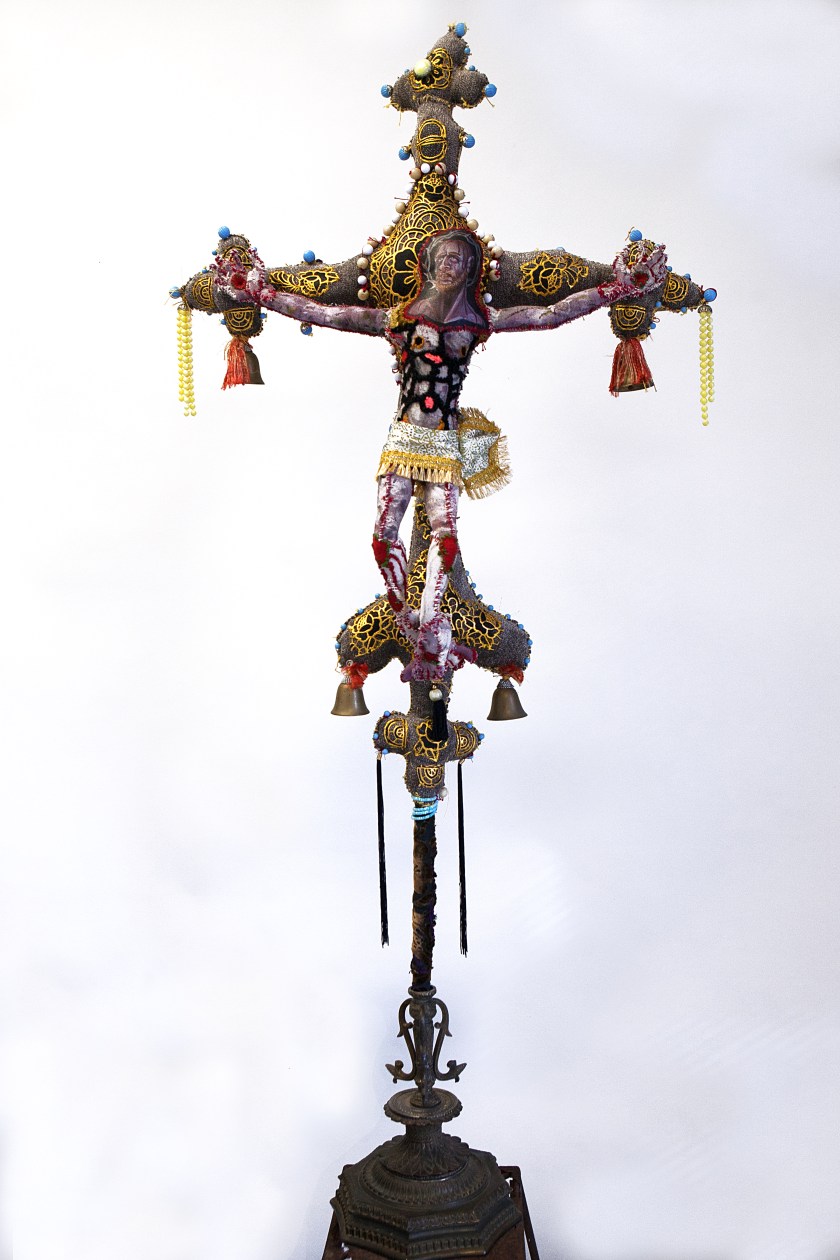
The Anchorite’s Crucifix 2019 Mixed media: acrylic painted canvas, recycled fabric, beads, bells, embroidery floss, black pipe interior structure, poly-fil, vintage furniture, metal work and fabric. 60 by 32 by 10 inches, Crucifix only; total installation varies upon situation.The Anchorite’s Crucifix detail shotOedipus & the Sphinx 2019 Oil on panel 12 by 8 inchesThe Conversion of St.Paul on the Road to Damascus 2019 Oil on canvas 48 by 36 inches
The following was shot twice, but honestly I cannot tell the difference, Version I:
The Temptation of St. Anthony of the Desert 2018 Oil on panel 18 by 36 inches
Version II:
The Temptation of St. Anthony of the Desert 2018 Oil on panel 18 by 36 inches
and that is it…
Robin Goodfellow 2018 Mixed media:acrylic painted canvas, recycled fiber, embroidery floss, black-pipe internal structure, plywood, poly-fil 63 by 36 by 32 inches
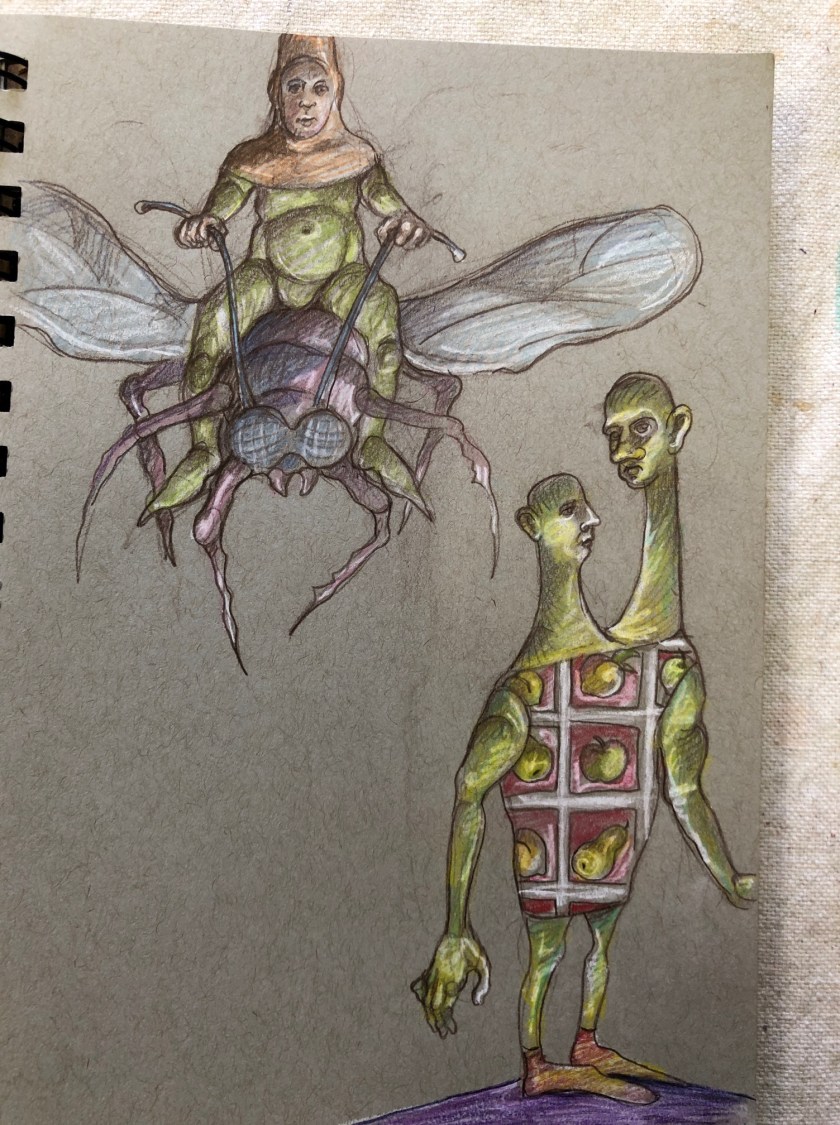
I recently self published my Fairyland ABC/Alphabetic Primer of Fairyland through Blurb, at first I was intimidated by the process, but in fact it was pretty straight forward, almost fun once my desktop was properly organized.
The link above allows for a preview of the book and direct purchase and shipping- just in time for the holidays! A perfect stocking stuffer ( that sounds a bit unchaste).
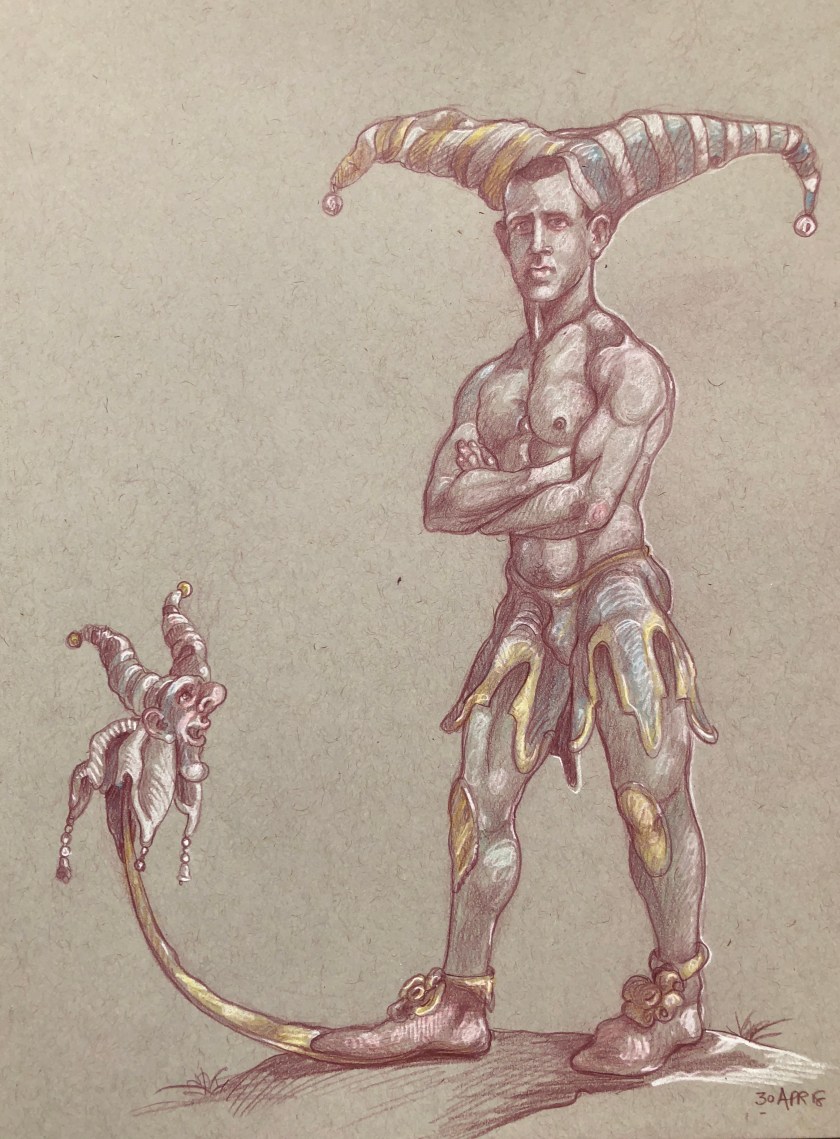
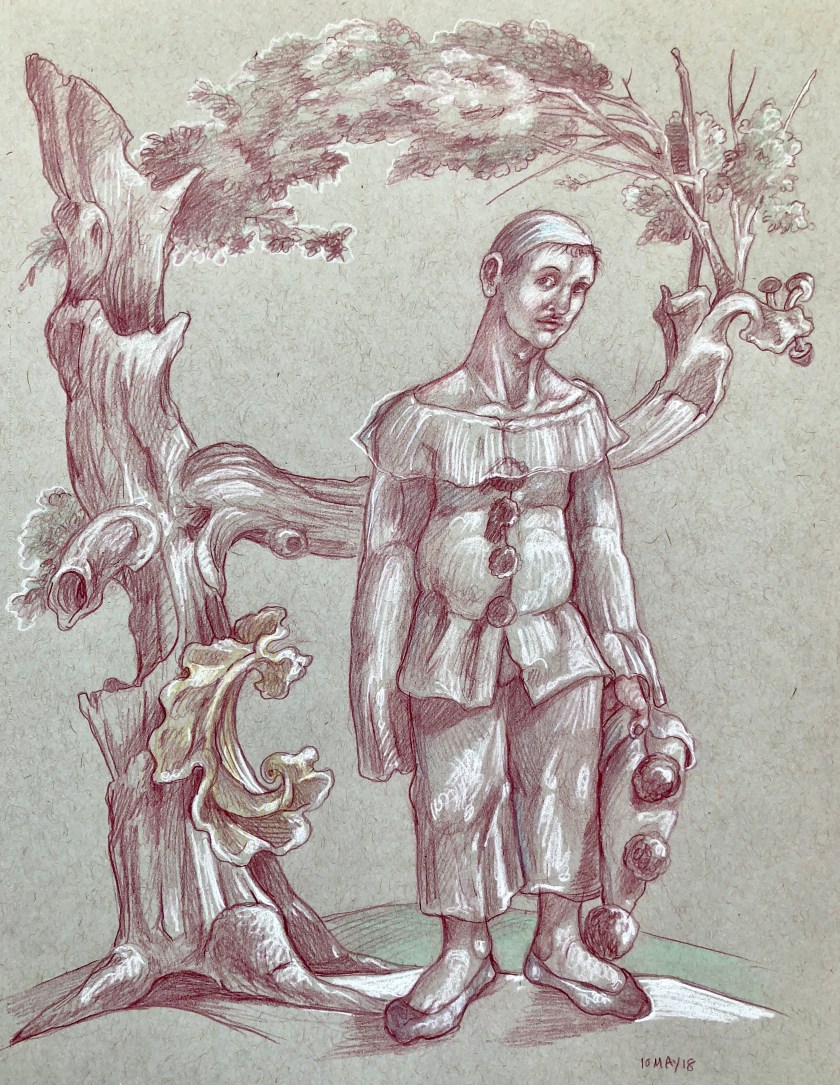
What started out as an extension of my daily drawing practice, my focusing upon the alphabet as inspiration ,quickly suggested itself to book format.This paperback edition is nearly true to size to that actual notebook (the private notations and wonky compositions attest to that day-to-day reality).
The following images are some of my personal favorites:
G is for Greenman (& Gryphon & Ganymede)J is for JesterP is for Pierrot (& Pollarded Trees)
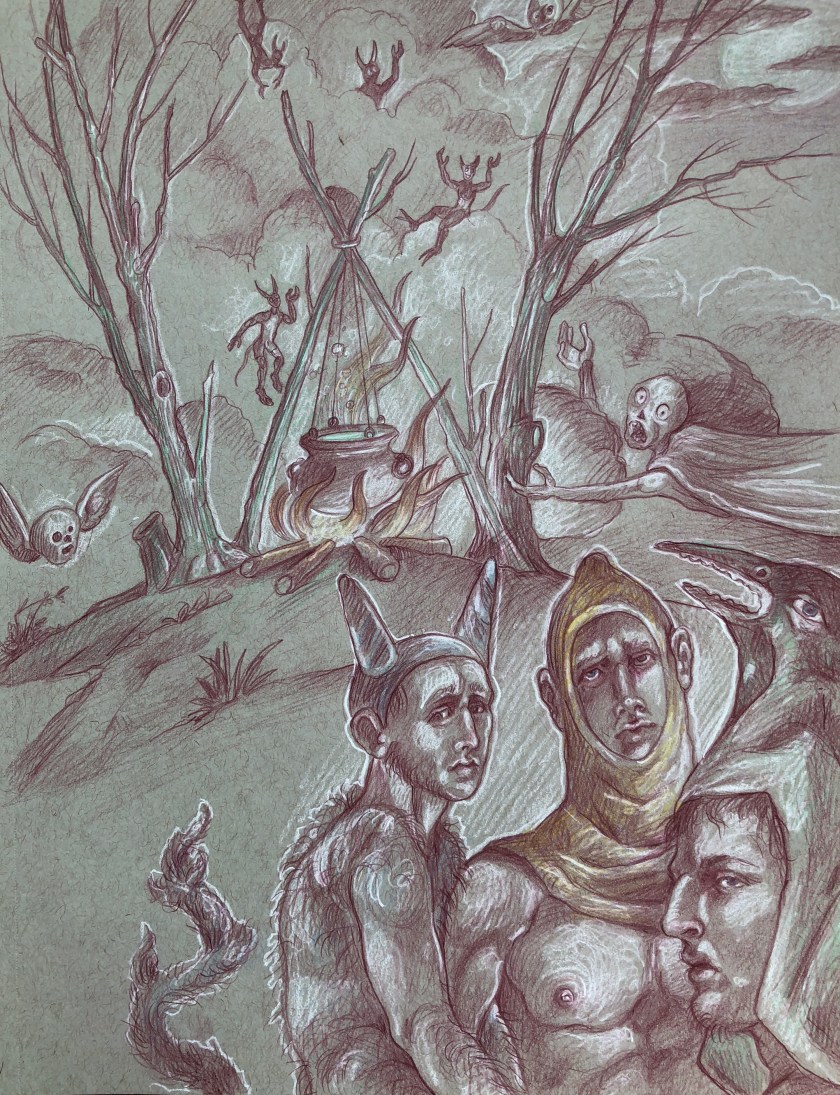
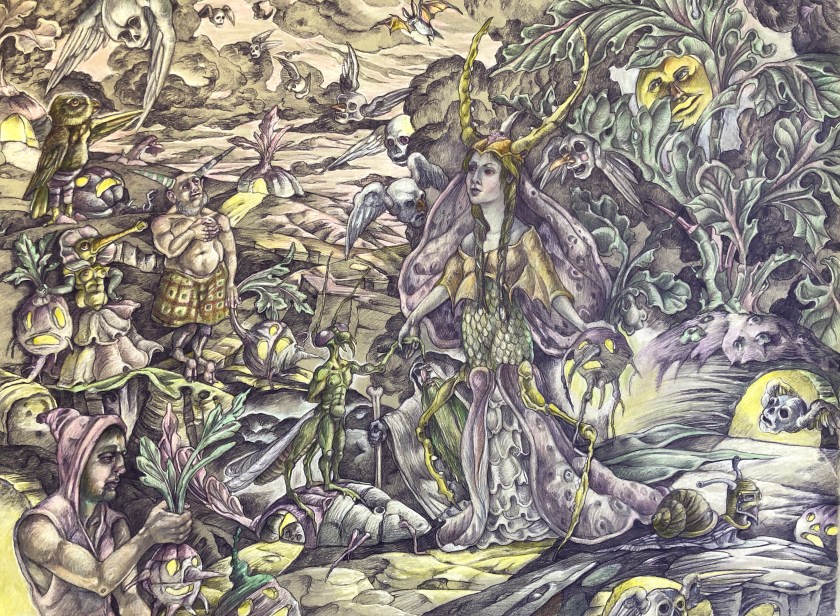
Samhain 2019 Colored pencil on toned paper 18 by 24 inches
I last posted what I had then thought to be a finished drawing, one I was pleased with in many ways but still had a persistent nagging sense of dissatisfaction concerning its resolution. But given other studio obligations I decided to put is aside and move forward.
However, a dear friend and accomplished artist in her own right would have none of that. In a private message she let me know in no uncertain terms what specifically was lacking, the email contained a red-inked copy of the offending drawing .
Suggestive red ink
I confess I was taken aback by this unsolicited critique, but given my respect for her, for her academic training and for her own admirable work, I put aside my embarrassment and instead picked up the pencil once again. I now believe the drawing to be complete…unless I receive another private message (smiley face).
Samhain 2019 Colored pencil on toned paper 18 by 24 inches
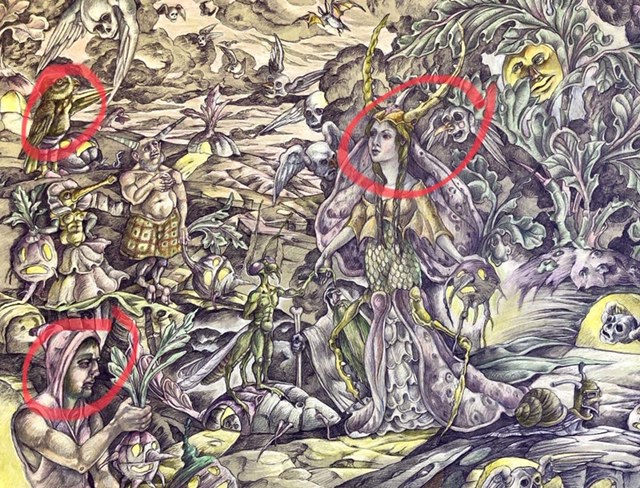
I recently finished a drawing celebrating Samhain which has just passed . Inspired especially by Victorian fairy paintings ( particularly those luminous works of Richard Dadd), I wanted to evoke that liminal moment , with lanterns and bonfires lit when we find the boundary between this reality and that of the Otherworld a bit more easily trespassed . If one wants to cross over into Fairyland, Samhain ( and Beltain) is your opportunity ; easy passage can be found also for the spirited Dead who may wish to cross over into our realm for quick hello with the Quick.
I love this Celtic recognition of two realms , side by side , each with inhabitants leading an existence separate yet interconnected to one another . A natural acknowledgment of what seems to be so apparent – I have only to refer to my own fertile dreamscape to believe that two realms run side by side . But which is the “real ” one ?
Samhain
2019
Colored pencil with chalk highlights on toned paper
18 by 24 inches
One of the many traditions I find so enchanting about this Celtic celebration, is the historic practice of carving humble turnips into lanterns – far more charming I think than the more photogenic pumpkin .
I also wanted to capture the spirits of the Dead , utilizing one iconic image over and over – that of the winged skull found on countless headstones .
I particularly like the idea of the Dead finding escape through ruptures in the earth , cave entrances etc – here I employed the turnip , that modest root vegetable that pleases me so greatly .
And of course, the ubiquitous bat .
Mumming and costume play, another tradition that I take delight in and hope I captured just a bit .
I had hoped to have finished this drawing on Samhain proper , October 31st through November 1st- certainly a broad window . But it just wasn’t to be . Though diligent , I’m not a particularly speedy artist .
Perhaps next Beltain I will revisit the realm of the fairy and the pixie and actually meet the deadline . Until then …
I love this liminal time of year , when the Otherworld is just a bit more accessible. When mummery , be it thrift shop finery or garments rich in folkloric significance can be found in the elevator, on the street , even at the dog park . When fairies , pixies, elves and ogres seem believable and where the day to day grind of this reality can be relieved by the fancy of the Other.
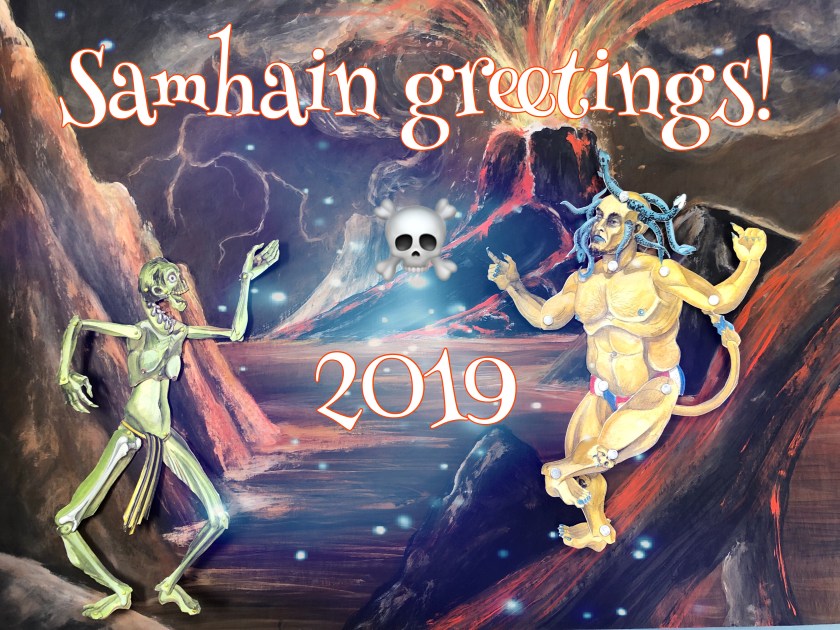
So as Los Angeles once again burns , I play with paper dolls and imagine a more playful , magical , liminal place .
Have a grand Samhain, Hallowing, All Hallow’s Eve 🎃👻🦇💀!
Resurrection of the Maize God (and the Miraculous Birth of the Hero Twins) 2019 Mixed media: recycled fabric, polymer clay, acrylic paint, embroidery floss, poly-fil, wooden cross 46 by 16 by 3 inches
I was recently asked to participate in a collective exhibition , the theme being The Afterlife. Ordinarily I avoid these mass group shows as they tend to be more inclined to spectacle and keeping the masses entertained (as the public never seems sated, craving new sensation after new sensation, we makers are asked to accommodate). But the curators are well regarded , one I know and respect, the art critic Shana Nys Dambrot, and it is after all a subject of keen personal interest.
El Velorio, as these annual celebrations of Dia de los Muertos are known center around a mass call for art, all loosely tied by a single element, participants receive ,via post, an object to base the work, this year it was a stock wooden cross.
The image above is my contribution.
Resurrection of the Maize God (and the Miraculous Birth of the Hero Twins) was inspired by the Popol vuh narrative in which the Maize God is slain/sacrificed and from this loss, new life, in this case the immaculate birth of the Hero Twins. An old familiar story, found across peoples, from John Barleycorn to Jesus Christ.
I had several years ago made the polymer clay heads for puppets, the puppets didn’t quite work out, but my rat-packing paid off as new life was found is this work. Unfortunately , from social media comments, the Hero Twin budding corncobs read as feet to the crucified Maize God.
I don’t read it that way, but it seems the public, in a mad dash to the next sensation, rarely actually observes.
Oh well.
That said, the work is available, along with many other very well crafted offerings October 12th at the Plaza de la Raza here in LA. I am told it is quite an event, very festive, costumed revelers. La Plaza de la Raza is a very fine art hub, actively community based and a vital center of artmaking; 40% of sales will benefit this wonderful resource.
Resurrection of the Maize God (and the Miraculous Birth of the Hero Twins) 2019 Mixed media: recycled fabric, polymer clay, acrylic paint, embroidery floss, poly-fil, wooden cross 46 by 16 by 3 inches
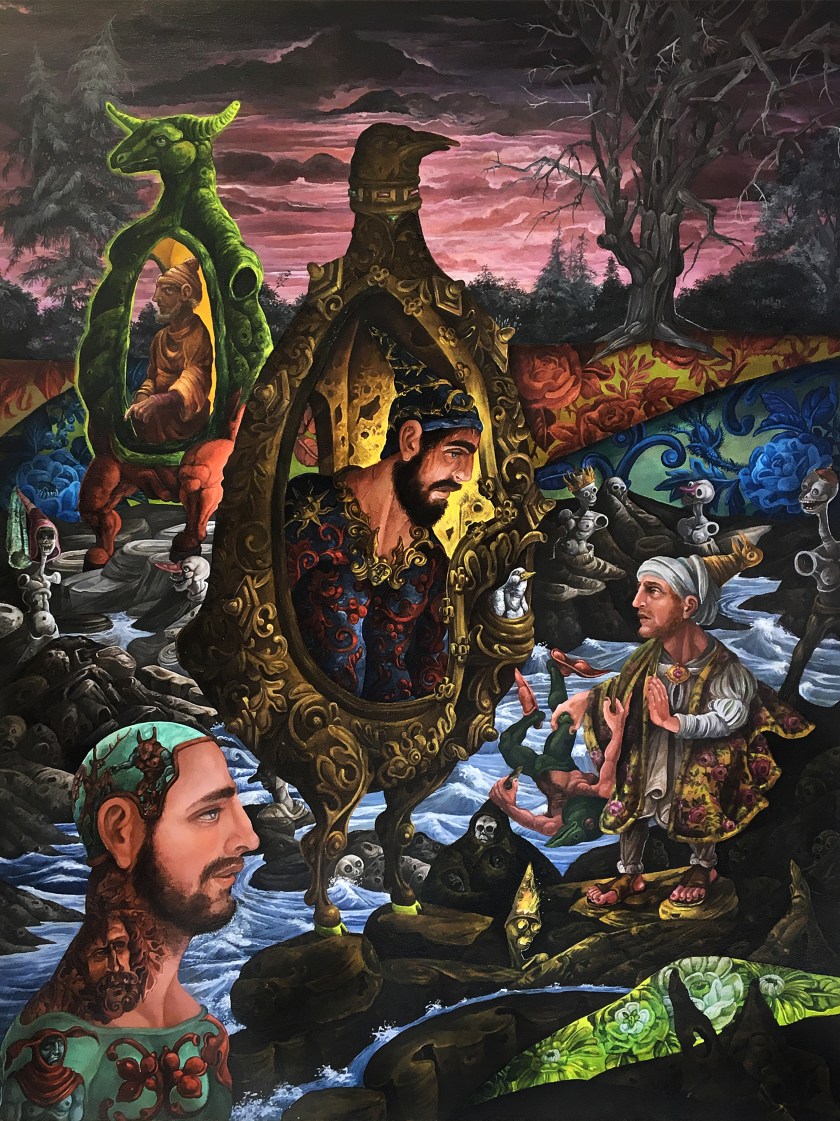
The Conversion of St.Paul on the Road to Damascus 2019 Oil on canvas 48 by 36 inches
I recently finished two new works, one a drawing which I made recently on the feast day of the Assumption of the Blessed Virgin Mary (August 15th), the other an oil painting of Paul’s epiphany on that road to Damascus so long ago. I’m becoming increasingly aware of spirit entering my life ( I do not know what else to call it) and my work. It has been subtle, random spontaneous prayer, something I neglected since boyhood; sneaking into churches furtively and unnoticed ; but most especially instances of incredible awareness, of a sense “rightness” at the most curious of moments. I don’t know what it is but I do know it is welcome and increasingly welcome in the studio as well.
I’ve always been drawn to sacred art, I collect it, I seek it out whenever I travel, David and I are drawn like moths to a flame whenever we encounter some beautiful chapel, church or cathedral. Yet I have resisted calling myself religious, and God forbid anyone calls me “spiritual”- milquetoast yoga clad , CBD ingesting, kale juicing LA dilettantes come to mind. But now my symbolist art is becoming increasingly sacred, and sacred in a decidedly Christian way. Not I hope in that pedantic , lock-step fundamentalist sort of way but in the best way, a very personal way, the way one hears and feels the spirit. No one else can depict those ineffable moments of presence but oneself and they cannot easily be explained or depicted, but art making and poetry are frequently very evocative and satisfying.
The Assumption of the Blessed Virgin Mary August 15th 2019 Colored pencil on toned paper 24 by 18 inches
My interpretation of Paul on that road is at best quirky, perhaps too much so, too personally esoteric…but I must paint as I see it. Christ is front in center, in some strange pompous vehicle, wearing some odd pointed crown of thorns; poor Paul, mid-strangle of some hapless Believer, looking up in wonder and shame ; and as always , in the background and foreground , are we, the unenlightened, unable to witness the sacred in our everyday.
I say “we”, I mean “me”.
Detail: The Conversion of St.Paul on the Road to Damascus
I’ve ornamented this bearded fellow with Greenmen, primal gods, folk treasures and a Fool. Although seeking something beyond the realm of the ordinary, I wanted to acknowledge the sacred qualities of being of the world.
The Fool is all seekers, of which I count myself. Seeker Fools, Holy Fools, wether ready for it or not; latent or actively seeking or somewhere in between. I predict many Fools in new works to come.
Of religious art I was taken with what I felt a very British approach to the sacred on my recent holiday visit to the Tate Britain. There in the dizzying galleries devoted to all that is best in British art,I was struck by the sheer numbers of works depicting Christ, the Magdalene, Virgins here and there, and just an over all presence of spirit (Blake of course comes readily to mind). But these works, unlike their counterparts issued from the Church of Rome were highly personal, some oddly so, as cryptic and as wonderful as some newly discovered Gospel.
As an example I suggest Stanley Spencer’s monumental The Resurrection, Cookham. In this detail shot, Spencer himself, nude as our Lord made him, languidly awaits his Savior.
Detail: Stanley Spencer’s “The Resurrection, Cookham”, 1924-7
For a sense of the scale of this fantastic painting, this image, with Jacob Epstein’s strangely beautiful Virgin from The Visitation, 1926 in the foreground.
Perhaps being a Protestant nation, British artists were more inclined to “own” the Christian narrative in their work as they feel able to interpret the gospels for themselves. I don’t know for certain of course but it was strikingly apparent that these works , of which there were many, expressed an inner life, richly experienced.
This seems a long standing tradition, although theoretically familiar with John Everett Millais’ Christ in the House of His Parents ( The Carpenter’s Shop), I hadn’t realized until close inspection how unorthodox a painting it really is. Christ, so young, so fair, so in need of his mother, the tenderness she exhibits as she tends to a superficial wound, the precursor to the Wound. Blood drips upon his bare, grubby little feet, again a foretelling. The painting is astonishingly rich in symbolisms, details I hadn’t been aware of from reproductions. In truth I’ve never liked this painting much, that is until actually witnessing it ; too Protestant, I had foolishly thought, not properly “sacred”.
I no longer think that.
Detail: Millais’s “The Carpenter’s Shop” 1849-50
But for highly personal visions of the divine one returns to Blake.
William Blake “The Body of Christ Born to the Tomb” c.1799-1800
Increasingly I feel Blake to be the strangest, most influential and most prescient artist. Although I don’t think that it was the case, I always sense that the work just rushed out of him, painting one might say in the Tongue of Pentecost. I don’t think that was true, that he was in fact quite a deliberate artist, but it is a tender image of the man.
Of Blake’s perennial influence, one cannot neglect Cecil Collins, and although from what I read he loathed to be compared to Blake, the influence of spirit is hard to overlook. Collins has become in his own right quite an influence to me. I feel a kinship to the work and to the man, I especially like this quote where he speaks of the Fool. It reverberates with a sense of rightness :
The saint, the artist, and the poet are all one in the Fool, in him they live, in him the poetic imagination of life lives.
Cecil Collins “The Sleeping Fool” 1943 Tate Britain
Back to my own stabs at personal spirituality, I came upon this photo of early work, from the early 80’s , back in those halcyon summer days of my youth, spent on Deer Isle Maine painting very strange, frankly ugly paintings onto the most forlorn cast off furniture I could find, which in turn was peddled to upstanding Boston Brahmans summering in Blue Hill ( a very respectable gallery gave me several solo shows, nearly all sold out- I was astonished). I haven’t a clue as to where this peculiar table ended up, I imagine once the buyer came to their senses they tossed it to the curb. Happily I have this crappy snapshot which provided compositional inspiration to my Assumption drawing above.
Assumption Sidetable 1984 (?)The Conversion of St.Paul on the Road to Damascus 2019 Oil on canvas 48 by 36 inches