Silly post, too much time on my hands apparently, trying to avoid weekend housekeeping…
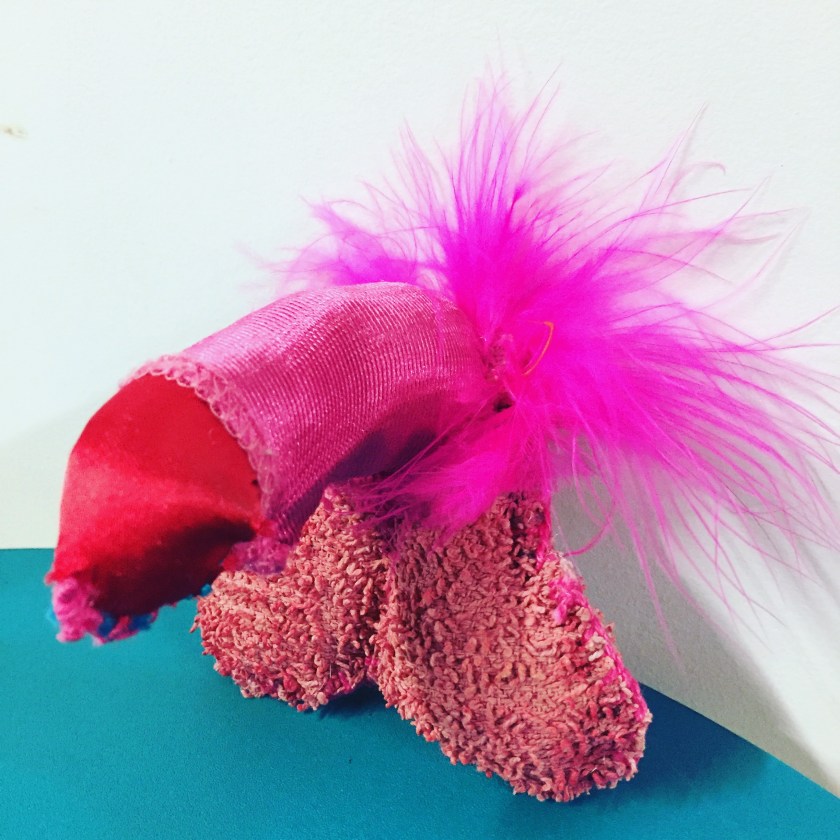
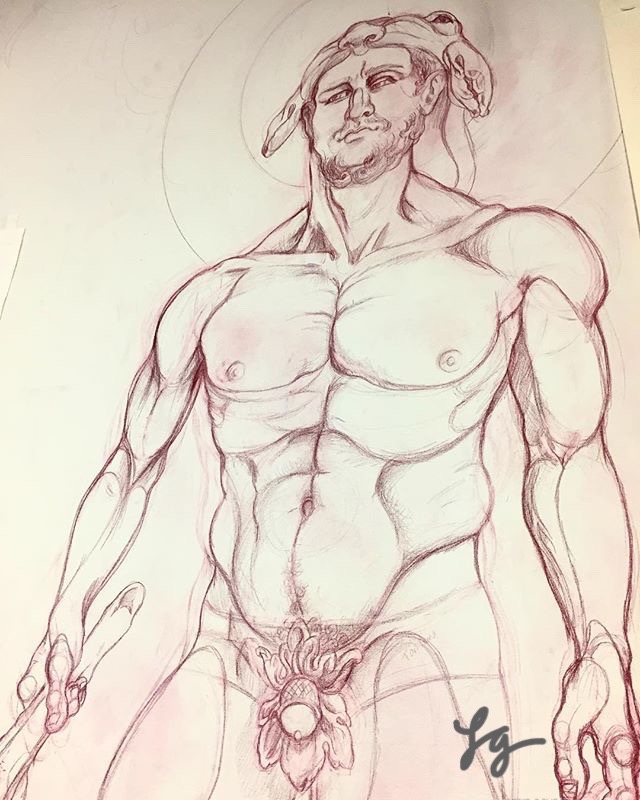
But in seriousness trying to navigate in my work how much nudity, particularly male, I should depict. When is it gratuitous? When essential? When just free expression? Still processing this question, but in the meantime, peen.
No intention to self censor, but I do want to be more mindful of my own intention. Recently , when we were still having dinner parties, a guest quipped that I painted “that pornographic art” ; in another situation I was referred to as a “penis painter”. Nothing particularly wrong with either but that hadn’t been my conscious intention. Nudity is an element to my work but I hadn’t thought it the main focus. Again, feeling more mindful of intention.
But enough naval gazing, I’ve scrubbing to attend to.
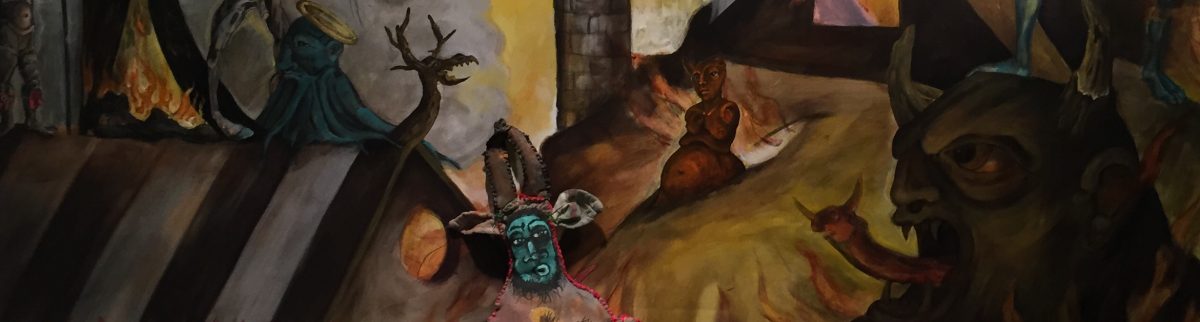
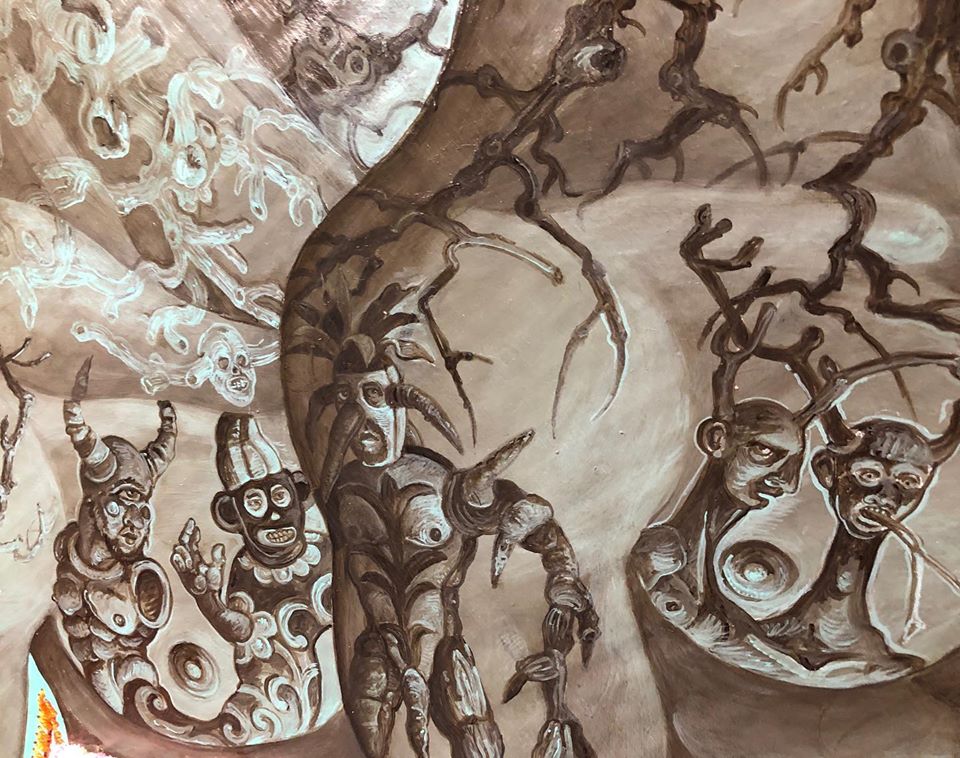
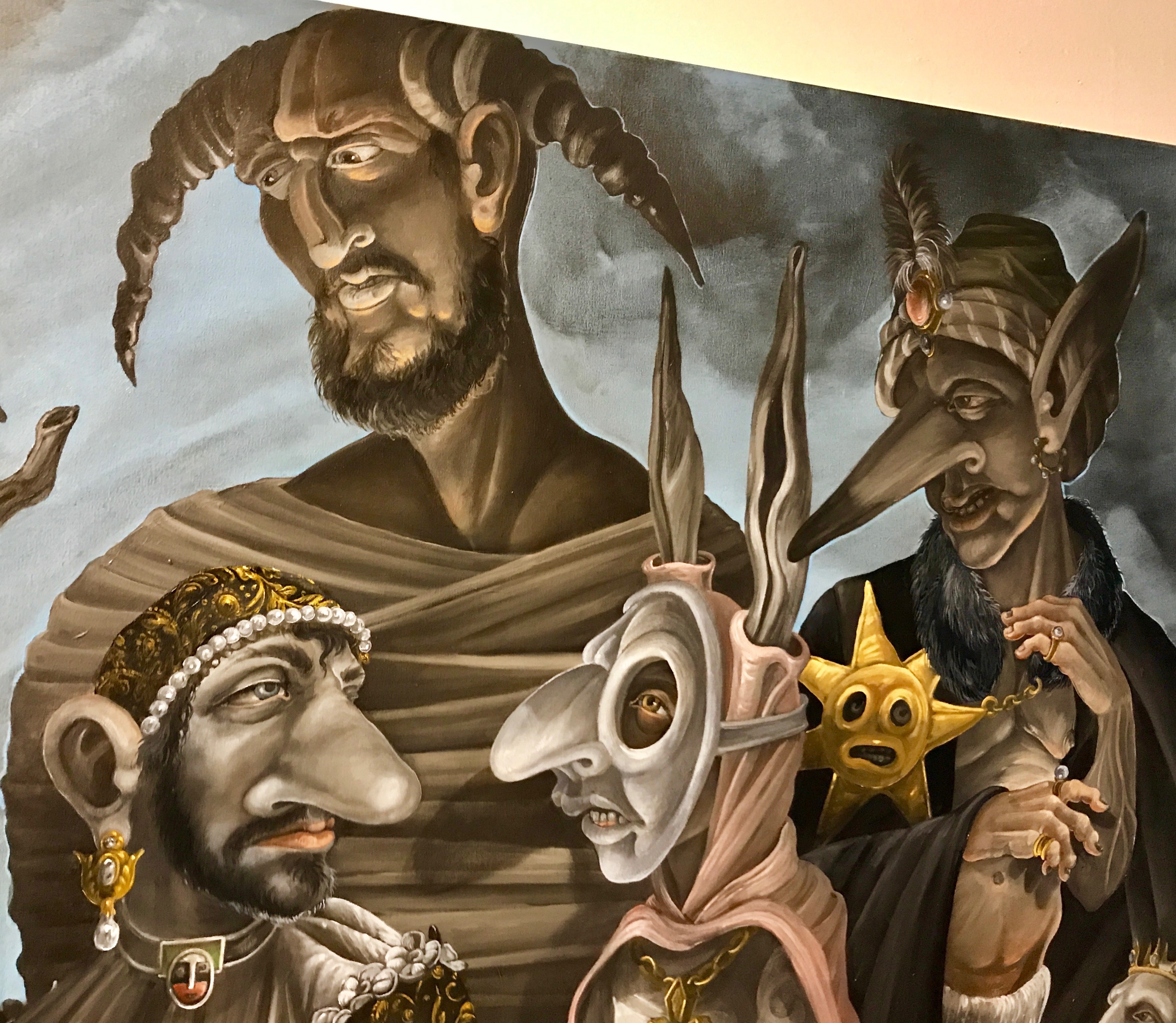
Latest painting inspired very loosely by Chaucer’s The Knight’s Tale ,the first yarn from the Canterbury Tales.
The Knight’s Tale 2020 Acrylic on canvas panel 18 by 24 inches
My reading group, the Agora Foundation, in enchanted Ojai California(https://www.agorafoundation.org/), has a Great Books focus and this reading season they selected works that consisted of narratives within a greater narrative, along with the Boccaccio’s Decameron and the Arabian Knights , Chaucer’s perennially relevant Tales were the reading offerings, all up for fascinating group discussion. By far Chaucer’s work was my favorite, the Decameron while bawdy and amusing was populated by characters a bit thin, I encountered difficulty in differentiating one from another; Arabian Knights I found unreadable, the macho blood thirsty violence, the rock solid foundation of misogyny , xenophobia and racism was repulsive, it sickened me, I wasn’t able to read more than a third. But The Canterbury Tales was a pure delight, and while The Knight’s Tale wasn’t really my favorite of the lot (that recognition would be for the Wife of Bath, most especially her rip-roaring Prologue) the Knight’s Tale was rich in chivalric detail masquerading in classical garb; low hanging fruit for a Neo-medievalist illuminator .
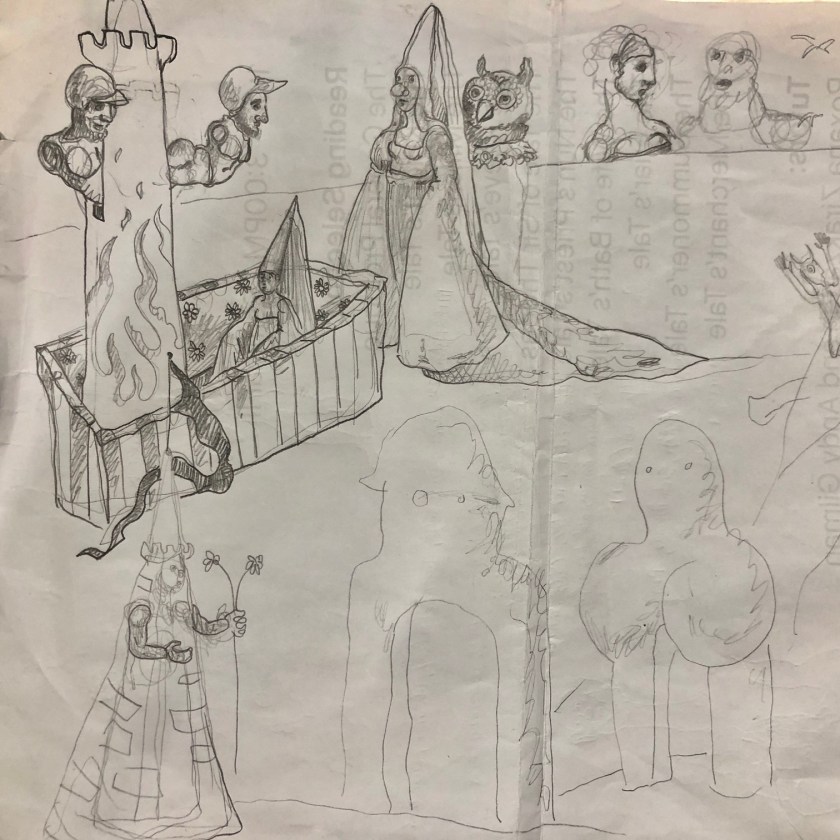
As much as I thoroughly enjoyed the book and was in fact eager to discuss it, digging deeper, when the time came to join the banter I was completely silent, my usual insecurities trumping any desire to participate. However during the discussion, which I did find illuminating, I once again turned to doodling my thoughts and responses. I’ve responded this way to social awkwardness since boyhood, very rarely would my voice be heard but my notebooks were packed with my feverish scrawling.
Below is an example from that day’s mute notebook:
Free associative sketch for/from “The Knight’s Tale”.
A few more details follow:
The Knight’s Tale detailThe Knight’s Tale detailThe Knight’s Tale detail
Given the isolation and pangs of reflection during this Covid plague, this painting provided some timely “content”:
That is it from here, hoping all, and this being global, truly all, that all stay sane, well and of good cheer.
The Knight’s Tale 2020 Acrylic on canvas panel 18 by 24 inches
The Temptations of St.Anthony of the Desert in an Italian Landscape (after Jakob Phillip Hackert, 1778) 2020 Oil on canvas 24 by 36 inches
Awoke this morning to a notification that my work (the painting shown) had been recognized by the Torrance Art Museum here in Southern California for their ongoing Hobson’s Choice. Hobson’s Choice is an online presentation of seven new artists per week, particularly encouraging and timely during this period of social isolation.
Thank you Torrance Art Museum for the support, personally and more broadly.
There comes a point that an artist just needs room, and storing works gets rather expensive, with that in mind I felt it time to actively try to offer my work to potential collectors. The link below will allow you to browse oil paintings, watercolor paintings, acrylic paintings, drawings, soft sculpted Stuffed Paintings-I will post more as I go through my files.
If you have any questions or requests for works not shown please don’t hesitate to contact me directly at neobaroque@mac.com, I’d be happy to chat with you.
LG
Link can be found on side bar under Available Work and here:
I haven’t posted in a bit, but my hands have been busy and so has my imagination. I’ve been making, clarifying and meditating upon the theme of Re-enchantment. I’ve mentioned before that my childhood was far from halcyon, more precisely grim in the lower case. Yet in spite of the anxious tension I was quite frequently in a state of wondrous enchantment. I had the good fortune to have a beguiling and magical woods behind our suburban home. A solitary boy, I spent hours in quiet delight, there was simply so much to explore : salamanders, bullfrogs, carnivorous pitcher plants, skunk cabbage, blankets of velveteen moss, fungi galore and most delightfully sweet and wise box turtles. Truly, who needed humans when such fairies and imps kept you company?
That enchantment has slipped a bit in my golden years, I stumble upon it now and then, in the garden, with my animal friends, but most especially in my studio (my studio is my sanctuary) but if I were honest, a great deal of my time is spent in pursuits far from enchanting.
Hence this interest in re-enchantment, in my work, in the studio and in my life. I am actively searching for the extraordinary in the quotidian, mindful and appreciative of the minor miracles of the day-to-day, the unfurling of the hairy leafed begonia, the topaz gold of a hornet, the diamond trail of the garden slug. My seven year old self was well aware of these delights, I’m in the process of being reacquainted .
Undated photo of yours truly, seven? nine?
In that spirit, a new body of work is emerging, I’ve coined it as Fairyfellers (inspired by the fantastic Victorian fairy painter Richard Dadd). Fairy-telling is my aim, visually expressing that wonder found in the gentler, enticing realm of toadstools, ferns and tadpoles.
The following are examples of some of my labors:
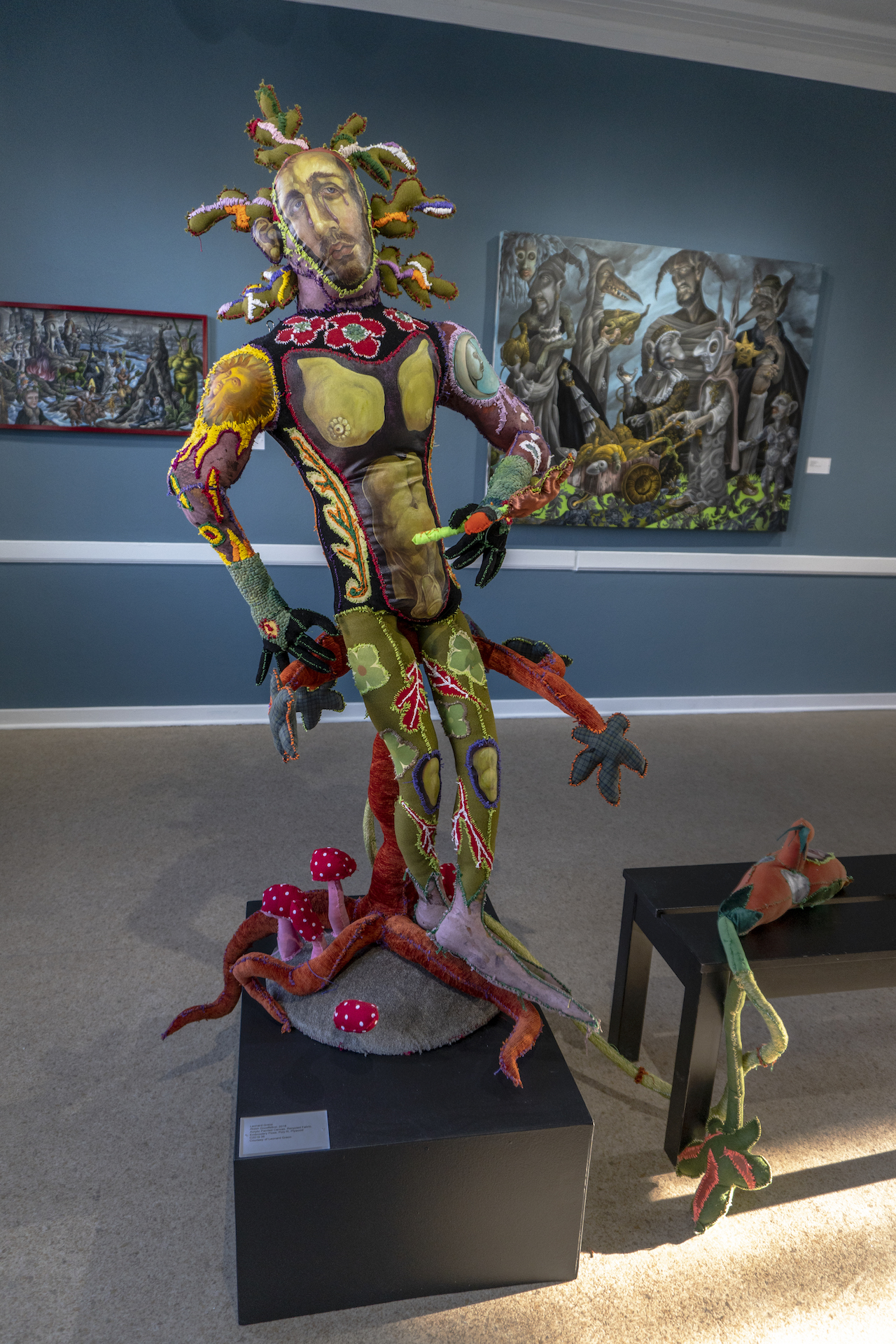
The Mandrake Titus, Defender Against Reality (he lost) 2020 Mixed fiber media 72 by 40 by 27 inches
Much of my time has been spent just sketching out re-enchantment, my studio journals are full of spontaneous bursts of wonder.
Fairyfellers, page from sketchbook
Concept sketch for The Mandrake Titus.
Initial pose for Titus, triumphant against Reality; I preferred him defeated. Truer.
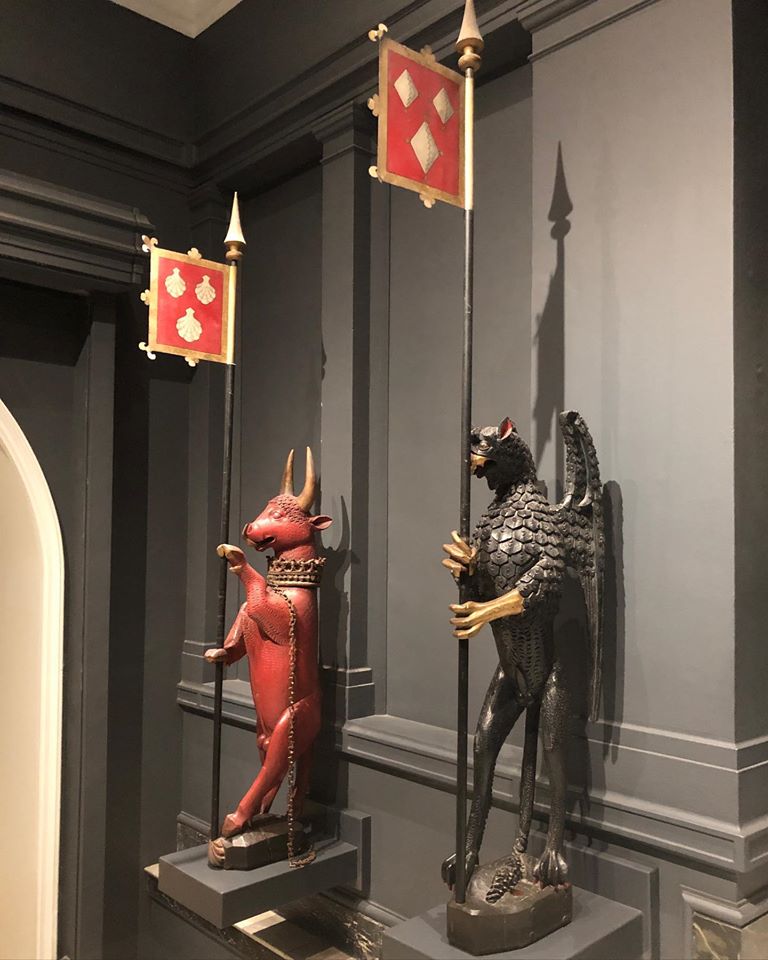
This figure of the Mandrake Titus was inspired by my visit to the V&A, in particular the heraldic, near life-sized Dacre Beasts.
Two of the four Dacre Beasts (1507-25) at the V&A.
In particular the heraldic banners, I’m wild for banners in general, these beasties compelled me to design and stitch up my own.
Artist’s sketchbook
Detail: heraldic Mandrake shield.
Reverse view of the figure.
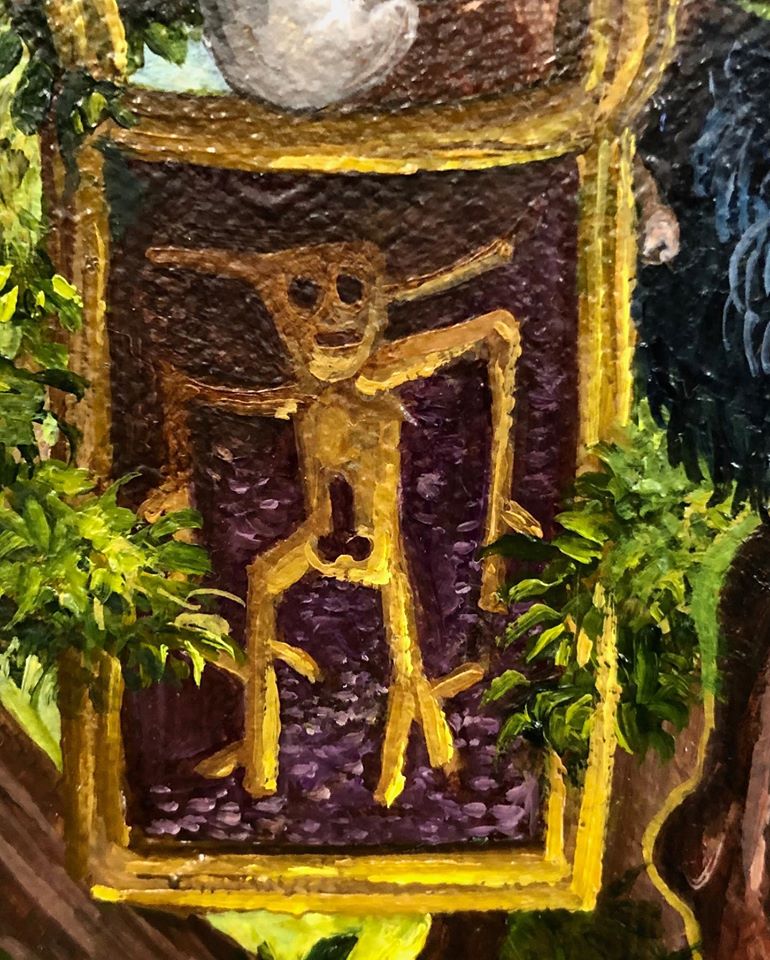
The Mandrake’s cape was inspired by a detail from my latest painting (previous post). Cross pollination of ideas , across mediums, is a common occurrence in my studio.
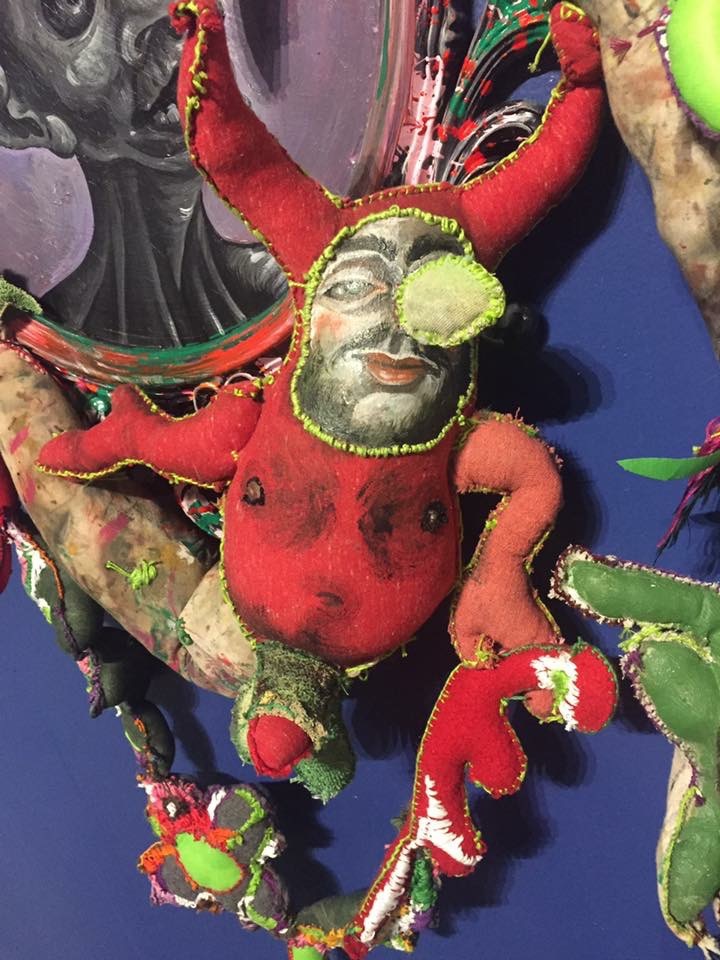
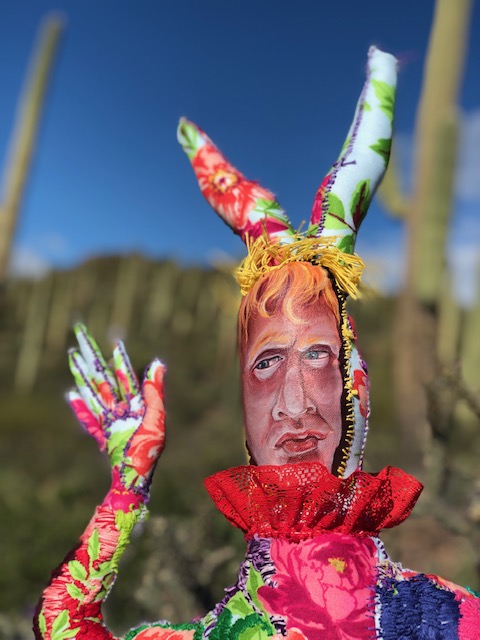
Further experiments in “stuffed paintings” resulted in this elfin trio of Fairyfellers: Rufus, Derrick and Seamus.
Studio shot of Rufus, Derrick and Seamus (and Robin Goodfellow).
Derrick and Rufus.
Rufus
Seamus
Derrick
I’ve also been busy working further upon paper-doll making (as fairyfeller an activity as you can imagine).
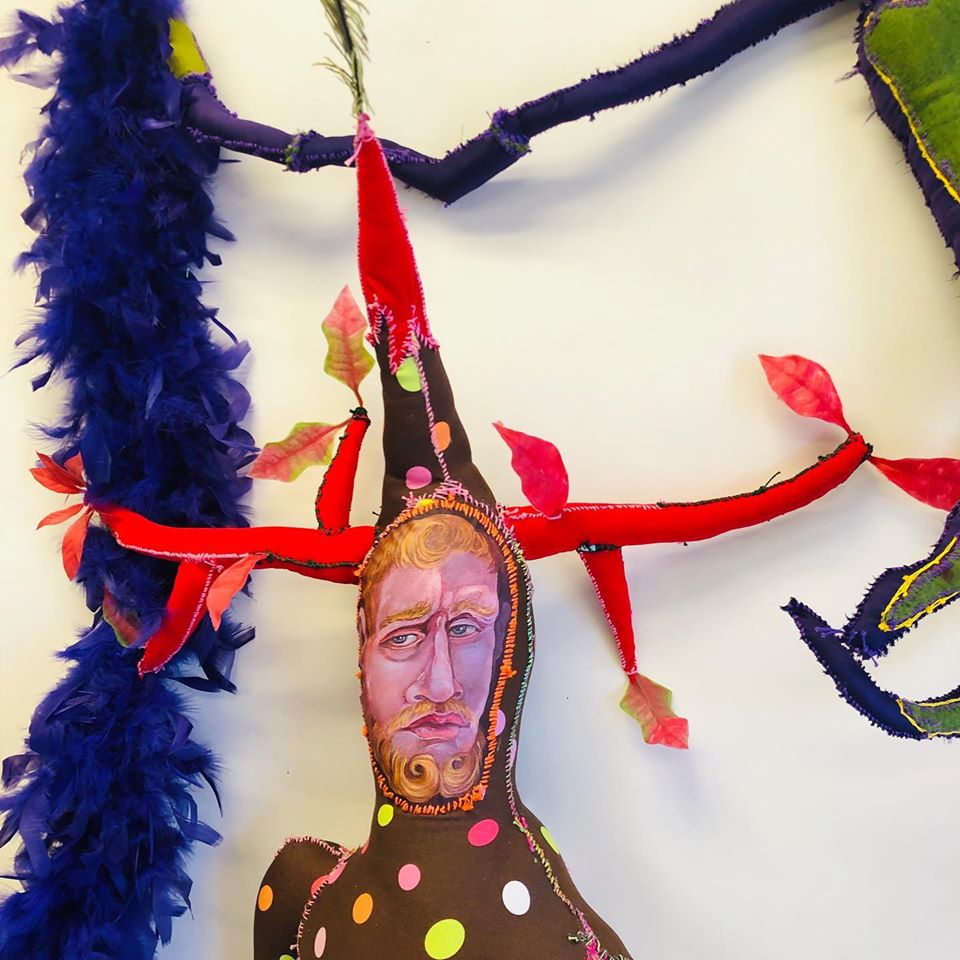
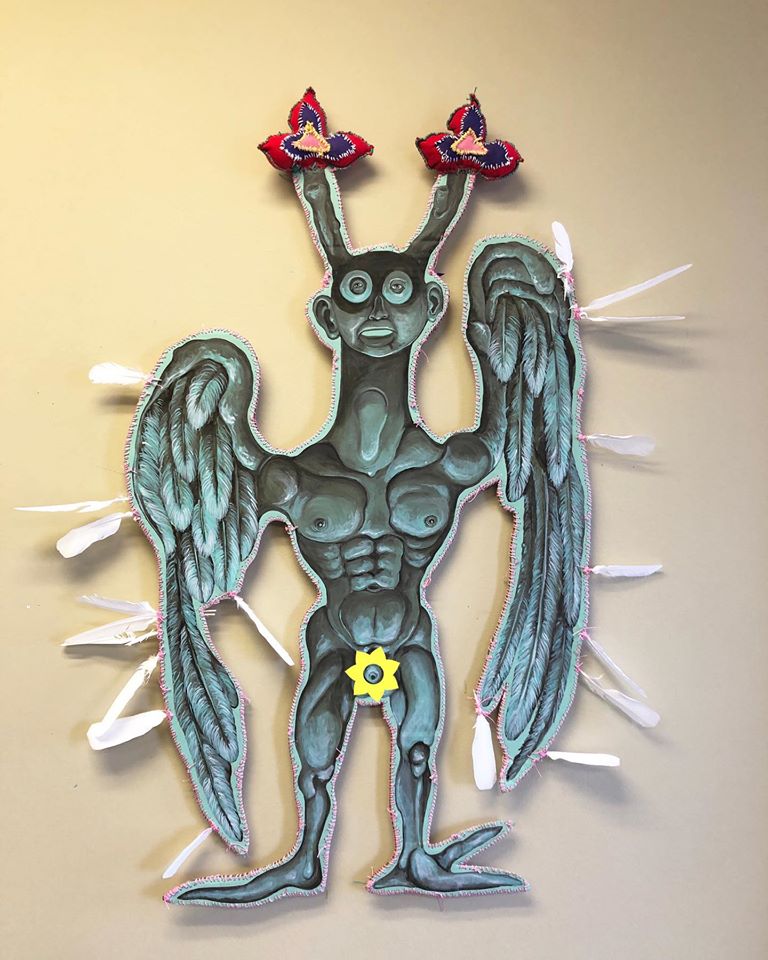
Daisy Chain 2020 Mixed paper and fiber media Approximate dimensions 96 by 51 inches
Concept sketch for Daisy Chain
Daisy Chain, detail
Daisy Chain, detail
Daisy Chain, detail
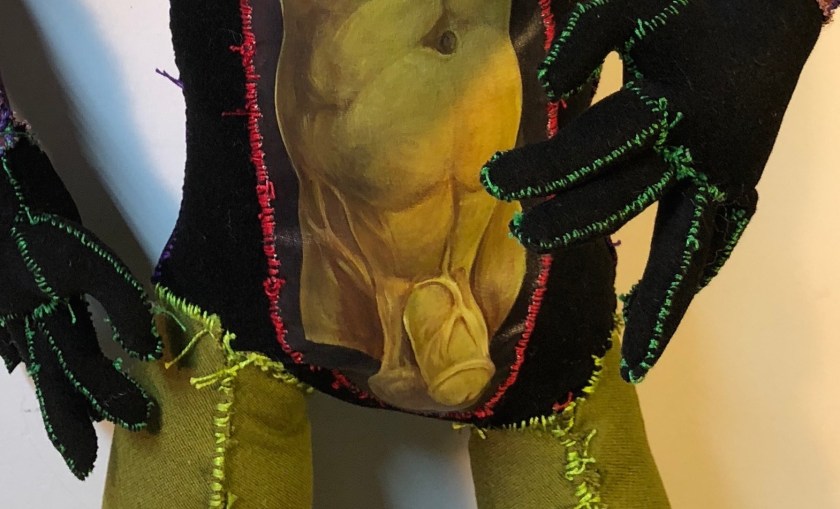
The last image of the daisy loin cloth betrays a bit of self censorship, increasingly I am re-evaluating how much nudity to portray. Not so much out of prudery, but I’ve heard myself described as a “penis artist”, and that isn’t my intention or interest. In this case I think the work is improved by the discretion, plus it is more playful; playfulness a key element of re-enchantment.
“Uncensored” detail
So far that is it in the Fairyfeller realm, more fairyfellers are on the way. Right now however I have returned to painting , stitching is hard work, my fingers begin to ache and the fabric and needle pricks have caused some damage to my fingertips. So for now this fairyfeller is at the easel.
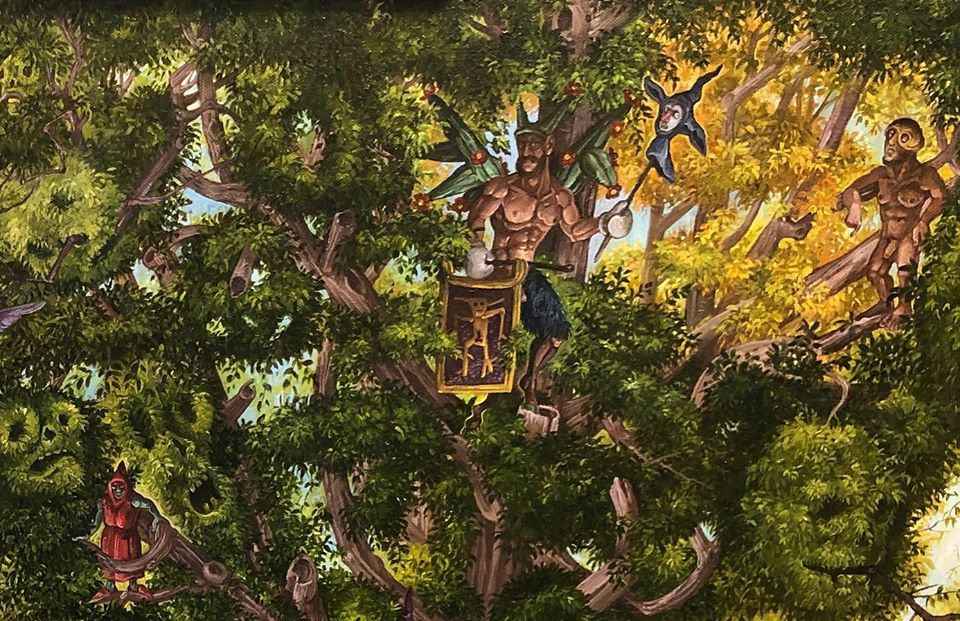
That darn anchorite keeps following me around, this time not so much in the desert but in a lush, abundant landscape inspired by the German Romantic painter Jakob Phillip Hackert (1737-1807).
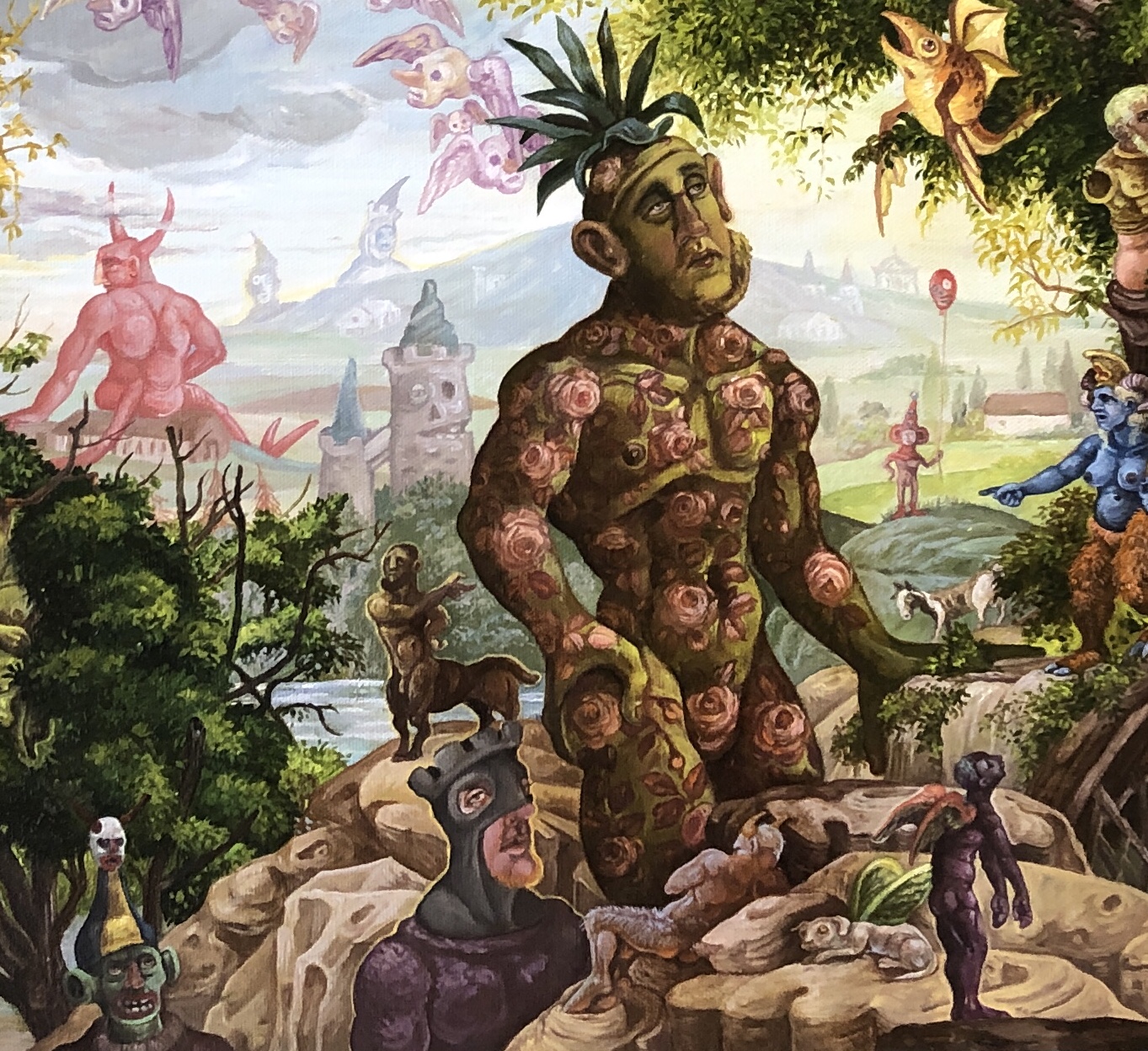
The Temptations of St.Anthony of the Desert in an Italian Landscape (after Jakob Phillip Hackert, 1778) 2020 Oil on canvas 24 by 36 inches
It wasn’t really my intention to once again return to Anthony and his desert travails, at least not yet (currently more immersed in fairylands, bogles, goblins and pixiefolk). But in my studio, kicking about and frankly in the way, was a practice landscape from a few years back. I’ve long admired German Romanticism, particularly the dramatic treatment of nature, most especially trees. In the hands of a master like Hackert, trees are major players, singular beings rich in personality. I had hoped to better understand how these landscapes/tree-scapes were constructed so I set about copying one of my favorites, Hackert’s Italian Landscape, 1778.
My copy of Jakob Phillip Hackert’s “Italian Landscape”, 1778
It was a gratifying experience, in no way was I able to match Hackert’s luminous original, but I did learn valuable lessons in light, perspective and composition.
But then I had a painting that I wasn’t very interested in, wasn’t original, wouldn’t/couldn’t show, not particularly “good” and yet frankly too sentimentally attached to to just chuck.
So I decided to make it my own by reworking it in my own way. I’ve seen artists self consciously take thrift store paintings (rather annoyingly, seems a bit stunt-ish), works they mockingly called kitsch, and adapt them to their generally ironic purposes. This sort of practice is close to being a kitsch cliche in its own right but it started the wheels turning .
I’m not an ironic artist, nor did I think my painting kitsch, although granted a rather poor copy, but I was excited to reimagine Hackert’s poetic composition, eager to populate his pretty world with my imps and daemons. In many ways old master Jakob acted (unwittingly) as my collaborator. This latest painting the happy result.
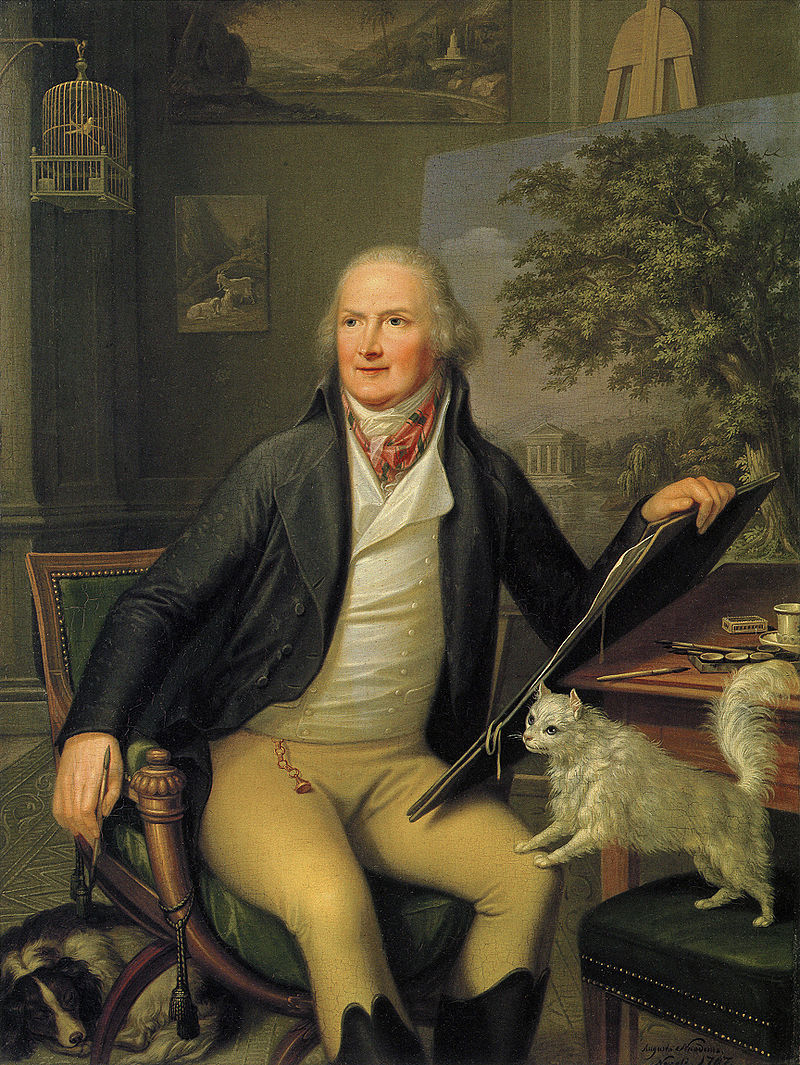
Portrait of Jakob Phillip Hackert (1737-1807) by Augusto Nicodemo, 1797
I hope he would have been pleased.
As my composition is visually dense in the Boschian/Bruegelian sense, details follow:
Detail
Detail
Detail
Detail of St.Anthony himself plus just a smattering of the gadfly temptations, oh, and his faithful pig.
This is the Master’s take, as you can see it is quite lovely, my copy so paltry in comparison. The wisest path was re-spinning my inferior version in my own voice.
Jakob Phillip Hackert Italian Landscape 1778
The Temptations of St.Anthony of the Desert in an Italian Landscape (after Jakob Phillip Hackert, 1778) 2020 Oil on canvas 24 by 36 inches
In the end I am pleased, I made room in storage, profited from past labors and have a new painting I like quite a bit.
In 1769 the Royal Academy first set about creating a space for showcasing new works of art, two hundred fifty two consecutive years of discovering, exhibiting and promoting contemporary art to the public. The Summer Exhibition is the longest open call opportunity for artists of all rank to present their vision to the Academy and to the world.
That is quite an impressive feat.
Through the centuries this progressive mission became associated with an institution that might have seemed stodgy and which one rebelled against. I’m guessing all that has changed , I really do not know but for a boy growing up in New Jersey the tales of Varnishing Day, the glamour of opening day, the imagined pithy comments from Oscar Wilde, all created a siren’s call impossible to resist.
I’ve dreamt of submitting for years (decades) but hadn’t the nerve. I still lack the nerve but this year I submitted anyway. It wasn’t an overnight decision. At my solo show last year I met a British couple enthusiastic about my work, amidst their welcomed flattery they pulled out their phones and showed me glimpses of the Summer Exhibition 2018 fantastically curated by Grayson Perry, encouraging me to submit my work for they felt it would be right at home. It was exhilarating this thought, feeling so out of place in Los Angeles, adrift in where to next turn, it seemed a dream; this Royal Academy was FAR from stodgy, far from my conceived notions of what “academic” art was. This was a magical place of wild color, classical architecture, and wall after overcrowded wall of diverse and distinct art just begging for attention. I was floored. This was an oasis, far removed from the frequently tedious , muted, reserved, overly-curated, predictable gallery exhibitions found here in surprisingly conservative , tight-laced and conventional Los Angeles.
When we visited London for the first time last summer the RA Summer Exhibition 2019 was a must-see. I had already toyed with the notion of submitting after having seen glimpses of the Perry show but heading into solemnly magnificent Burlington House, situated in glamorous Piccadilly, in the very heart of London, then finding inside these impressive walls an abundance of art, art of all sorts, a staggering diversity of material, style and approach, all this sealed the deal.I was immediately convinced that I must at least try.
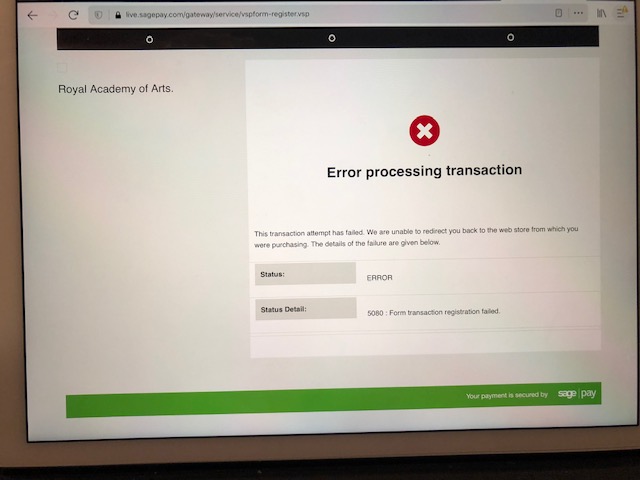
The long anticipated open call was announced this week on Monday. I was prepared and at the gate: all work freshly documented; a revised, suitably Anglophilic artist statement self-consciously composed; measurements and prices converted to metric and pounds. I was ALMOST confident. Nervously I typed in all the necessary information, exhibition submissions are always harrowing for me, but because this was so personally important it was especially so. But I soldiered on, all in order, all checked, double and triple checked, and then just when I attempted to pay the entry fee (entry fee is due before you can submit) I hit a wall, an unmovable glowing , unyielding wall on my laptop screen.
ERROR, error, error, unable to process. I tried again and again, rechecking triple checking every entry information, David checked, my publicist checked, we resubmitted, shut down, rebooted, cleared cookies and caches (whatever the heck they are), different browsers, computers, laptops, I-phones all to know avail. I contacted the RA support, they responded but the suggestions made proved unfruitful. I despaired, over-reacted, overwrought and self-pitying I was convinced I of course wasn’t worthy to even submit to the RA. I was such a loser they wouldn’t even take my money. In my pathetic state, eager to have them like me I became a Friend of the Academy…something I wanted to do anyway, but felt , hey, they’ll see I’m not some obnoxious self absorbed American. All absurd of course, it was some glitch, my rational brain knew this but I possessed such desire to just submit that I became quite abject in my disappointment and despair. It was resolved of course, my subsequent, pitiful emails were returned , a helpful assistant recognized the problem immediately and the Error message miraculously disappeared. With the error corrected (my fault of course) all was well, the submission window hadn’t suddenly closed in twenty four hours as I had ridiculously obsessed over, fees were paid, all was processed, entered, and the submit button nervously pressed.
The glitch? I had spelled out “California” instead of the required CA…damn California.
If I was irrationally anxious about the submission, I was irrationally proud of myself for actually having completed the task. The work that follows is what I, in the end , decided upon submitting. Perhaps not the wisest choices or most prudent, for they are large and unwieldy , and if the heavens allow and I am ,on the slimmest chance, shortlisted, the work will need to be seen up close and personal. This will be enormously expensive, but let me tend to that when and if it must be tended to. For now I will bask in the glow of an overly inflated sense of accomplishment.
I will receive first round results mid March …wish me luck.
Goblin Market 2017 Oil on canvas 122 by 152 by 5 cm 48 by 60 by 2 inches
Goblin Market, detail
Goblin Market, detail
Robin Goodfellow 2018 Mixed media: acrylic painted canvas, recycled fabric, embroidery floss, pipe/plywood interior structure, Poly-fil 161 by 92 by 81 cm 63 by 36 by 32 inches
Robin Goodfellow, reverse
Robin Goodfellow, in situ
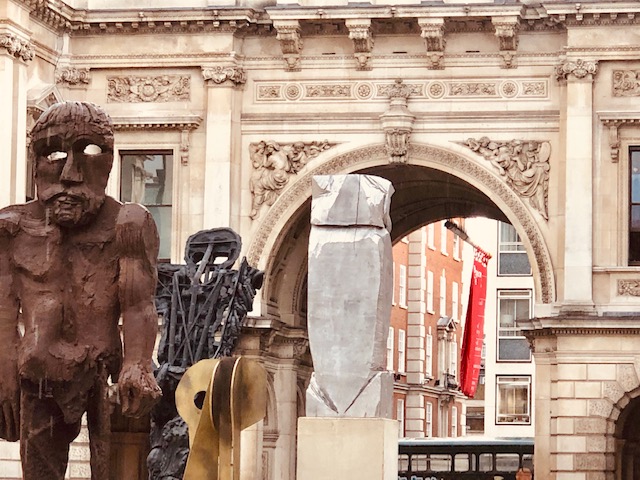
I will close with a happy memento from our visit last summer , my Herakles and that Farnese imposter.
In anticipation of 2020 and various upcoming submissions I decided it was time to have some newer work better documented- the I-phone is a wondrous tool but it has its limitations in my hands. The following images are the result of a recent photo shoot.
Robin Goodfellow 2018 Mixed media:acrylic painted canvas, recycled fiber, embroidery floss, black-pipe internal structure, plywood, poly-fil 63 by 36 by 32 inches
I had this piece, one I like quite a bit, professionally photographed during my Fairyland solo show , but the in-situ placement offers visual distractions that a time-pressed curator most likely hasn’t the time for.
Robin Goodfellow 2018 Mixed media, recycled fiber 63 by 36 by 31 inches
Other works:
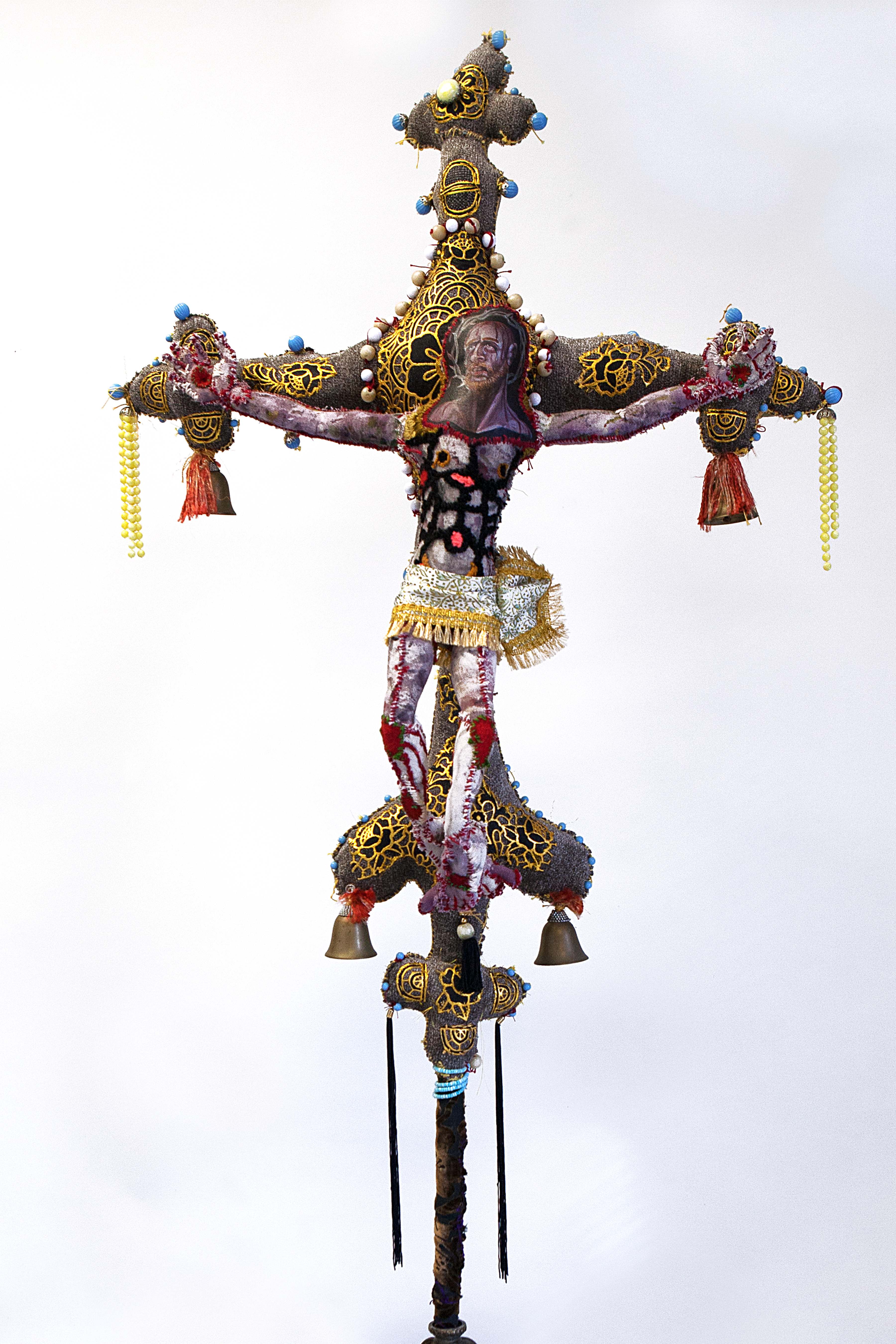
The Anchorite’s Crucifix 2019 Mixed media: acrylic painted canvas, recycled fabric, beads, bells, embroidery floss, black pipe interior structure, poly-fil, vintage furniture, metal work and fabric. 60 by 32 by 10 inches, Crucifix only; total installation varies upon situation.
The Anchorite’s Crucifix detail shot
Oedipus & the Sphinx 2019 Oil on panel 12 by 8 inches
The Conversion of St.Paul on the Road to Damascus 2019 Oil on canvas 48 by 36 inches
The following was shot twice, but honestly I cannot tell the difference, Version I:
The Temptation of St. Anthony of the Desert 2018 Oil on panel 18 by 36 inches
Version II:
The Temptation of St. Anthony of the Desert 2018 Oil on panel 18 by 36 inches
and that is it…
Robin Goodfellow 2018 Mixed media:acrylic painted canvas, recycled fiber, embroidery floss, black-pipe internal structure, plywood, poly-fil 63 by 36 by 32 inches
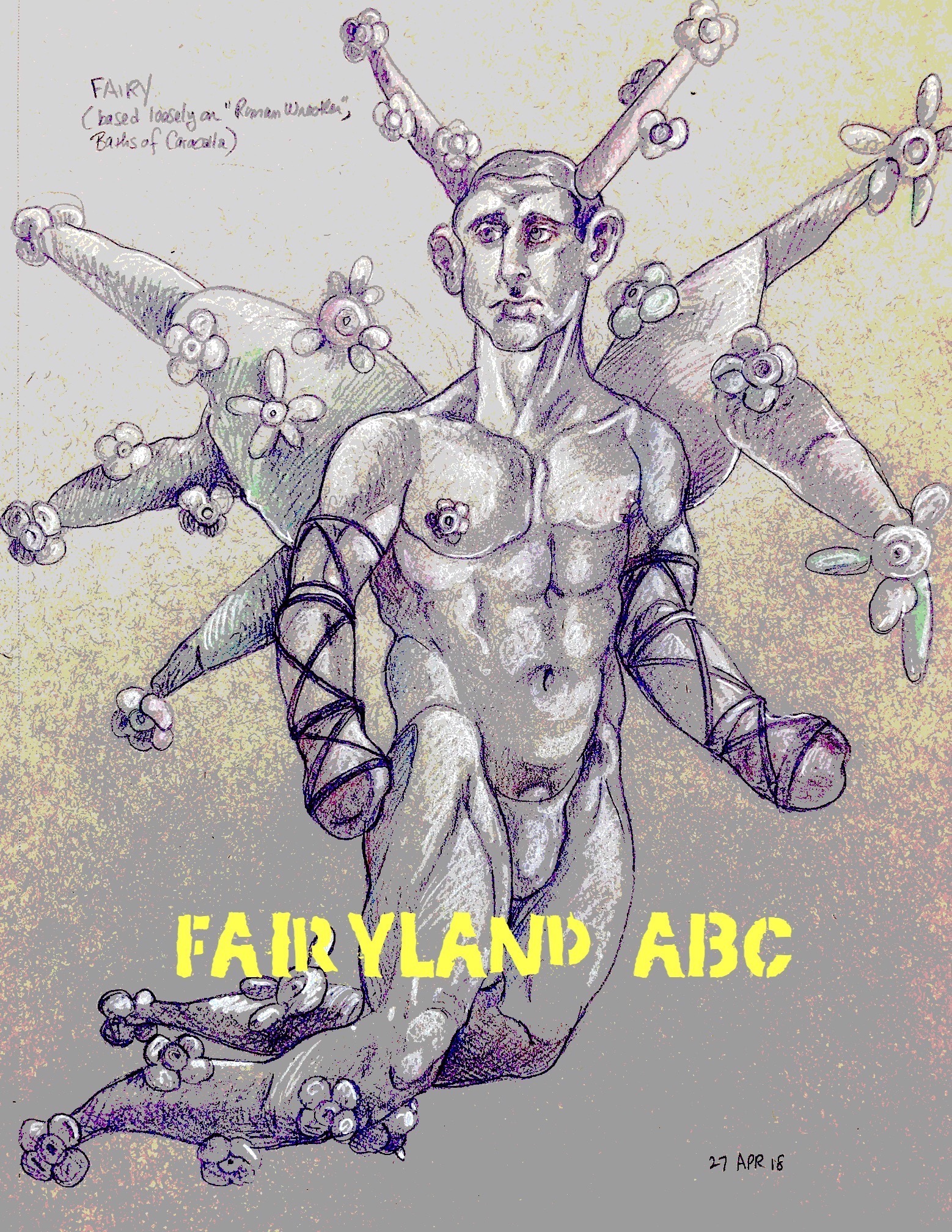
I recently self published my Fairyland ABC/Alphabetic Primer of Fairyland through Blurb, at first I was intimidated by the process, but in fact it was pretty straight forward, almost fun once my desktop was properly organized.
The link above allows for a preview of the book and direct purchase and shipping- just in time for the holidays! A perfect stocking stuffer ( that sounds a bit unchaste).
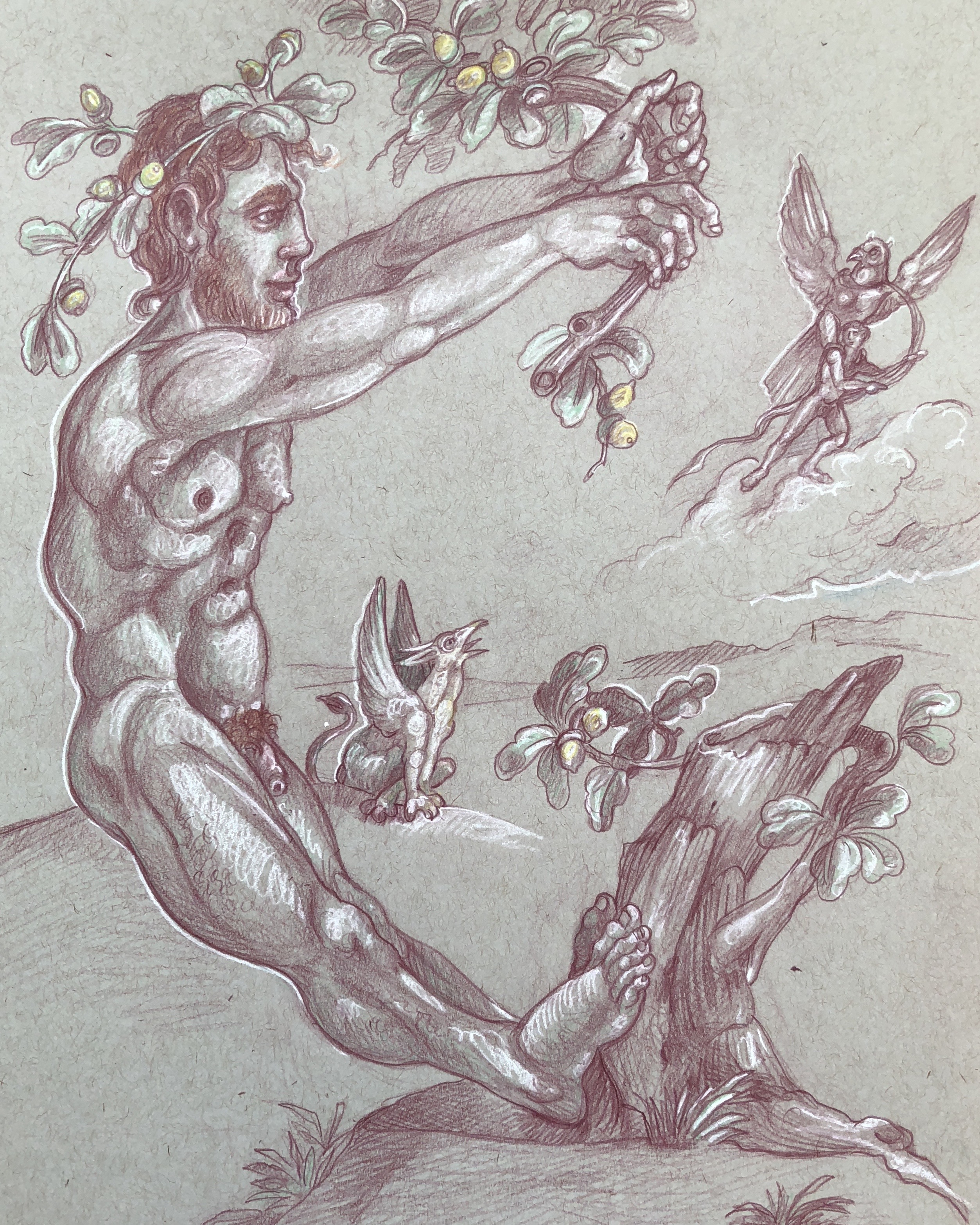
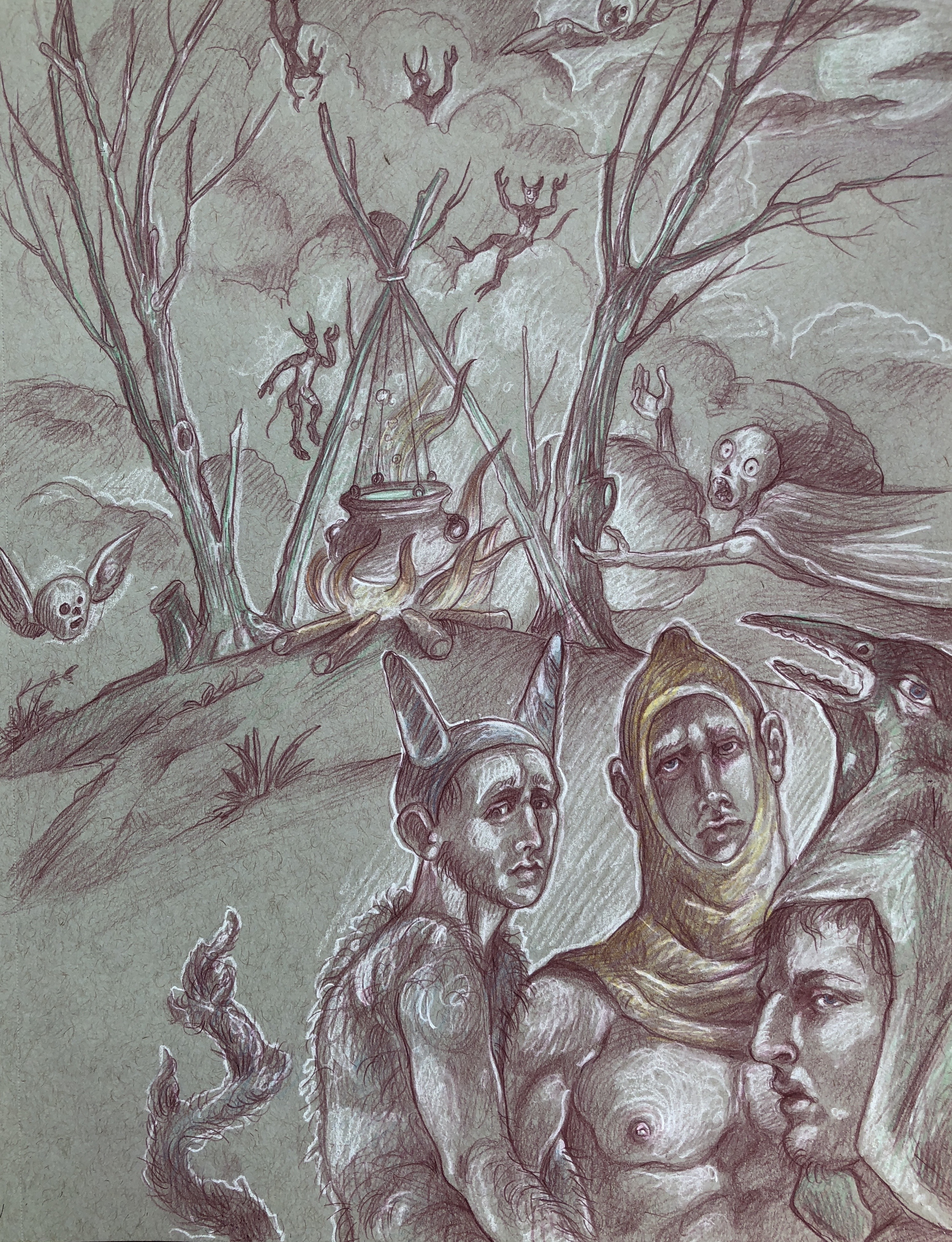
What started out as an extension of my daily drawing practice, my focusing upon the alphabet as inspiration ,quickly suggested itself to book format.This paperback edition is nearly true to size to that actual notebook (the private notations and wonky compositions attest to that day-to-day reality).
The following images are some of my personal favorites:



































 Boondocks Babylon