I recently finished Madeline Miller’s very excellent The Song of Achilles, Clive Hicks-Jenkins had suggested I read it, so I was quick to order a copy for myself. I had heard of the novel, I had read a scathing review of it in the New York Times and foolishly I held back from reading it. The reviewer, Daniel Mendelsohn , was ruthless (from my persective) in his criticism of the novel. Most of his harsh judgment seemed aimed at the unabashedly romantic depiction of Achilles and Patroclus, comparing it to Dawson’s Creek – about as a cruel a comparison I can think of.
Mendelsohn takes Miller to task for stating the obvious (to him at least) – the romantic nature of their relationship .
The truth is their relationship while implied, is not a given fact to the population at large as Mendelsohn asserts. There is a sacredness to their narrative, a romance held dear by a great many gay folks through time, that was secret and coded. It is no small matter that Alexander and Hephaestion made a pilgrimage to their tomb. If Miller’s prose was too purple for Mendelsohn then frankly that is too bad; I for one relished the evocative images she created. It is high time for some frank, direct depictions of gay love, culturally we have settled for the implied. Miller gave us a sweeping romance, I thank Miller for that, florid or not. In response I created an equally purple image of the two re-united for eternity in the Underworld.
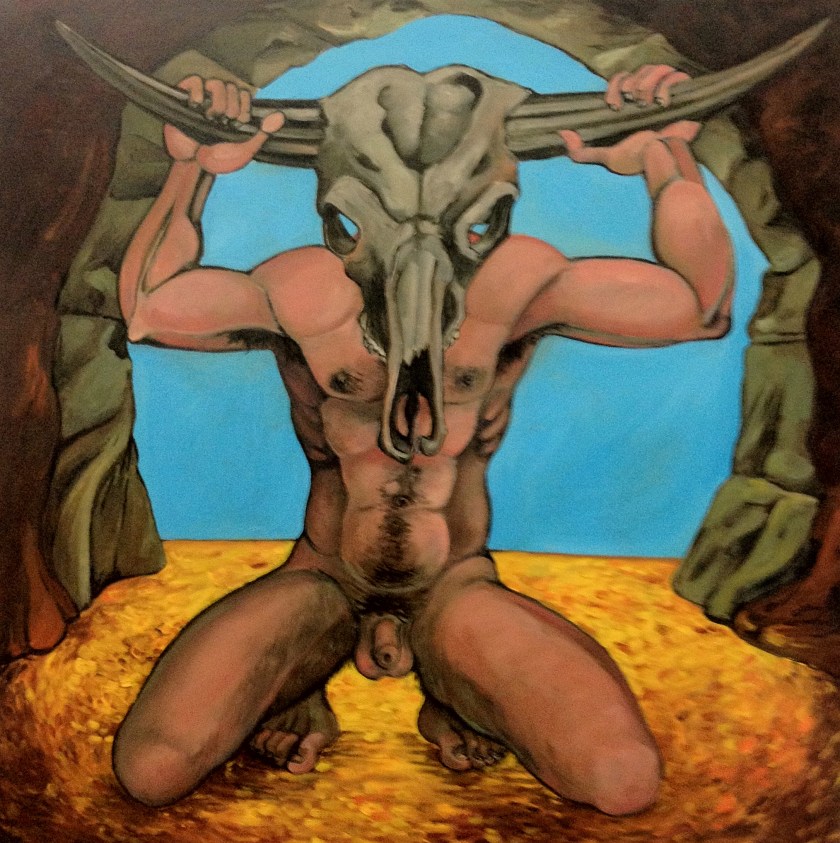
As 2012 nears to end I am tidying up the studio and finishing up what paintings I can. One such painting is this small oil (20 by20) that follows, The Widow Theseus.
It is a continuation upon a theme, that of the relationship between the monster and the hero, who is the victim, who is the victor.
The Widow Theseus
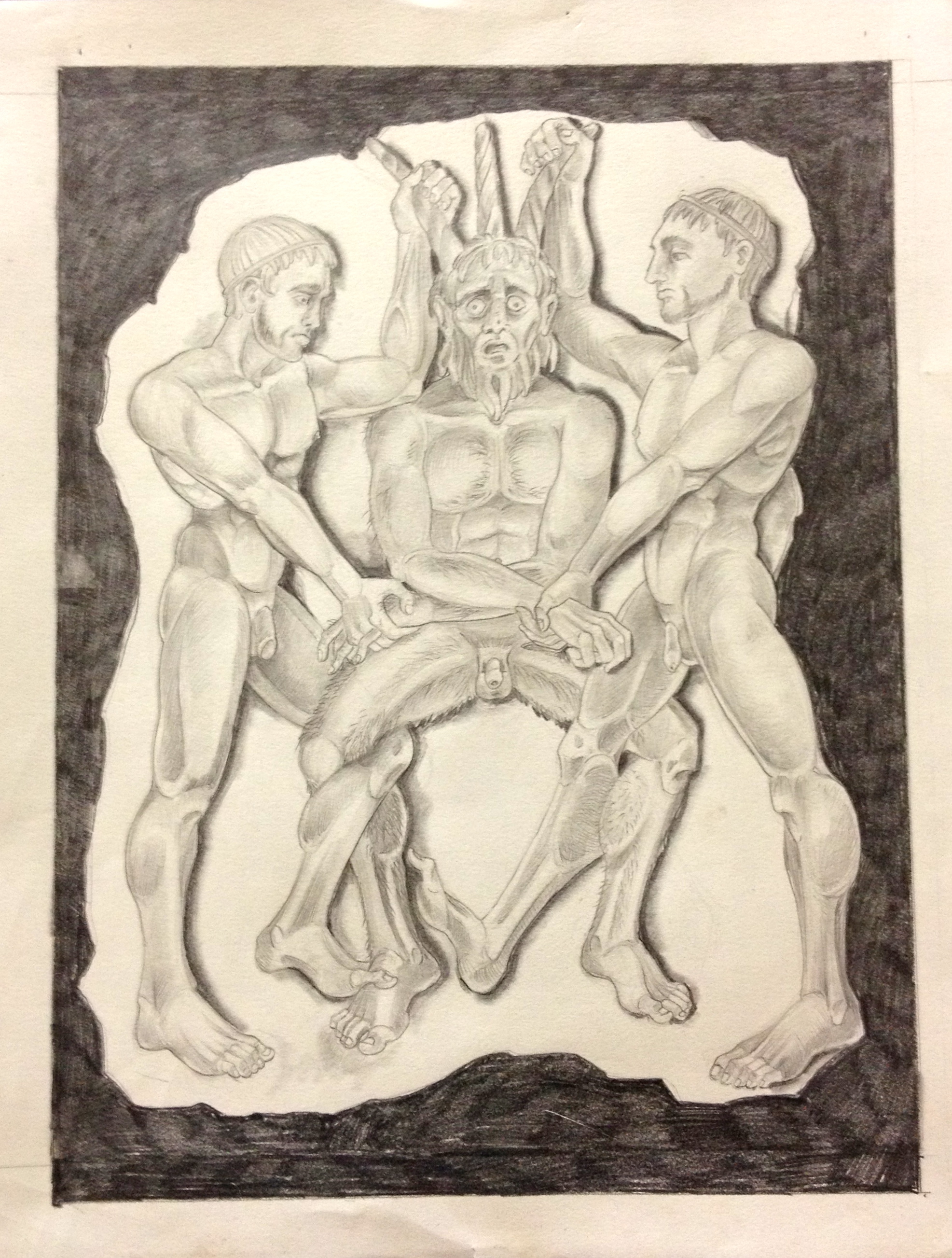
As I mentioned it is part of theme I have explored in previous posts (filed under Theseus and the Minotaur) and more recently in my printmaking class. I also dabbled a bit in the unfamiliar medium of pastel (and graphite). The following is the result, The Approach of Theseus, 12 by 18 inches on paper.
Printmaking has been an enjoyable challenge for me, not unlike clay work. I enjoy the process, have tended to dislike my results. I have made numerous prints of the Minotaur, few pass muster. The following, though far from perfect is approaching what I am after. Once again it is based upon a very loose sketch and once again I am relatively pleased with the translation.
The Broken Minotaur relief print on paper
This so far is what I have , will most likely continue upon this them throughout the new year.
I’m seeing a Jungian. In his rather bleak waiting room he has a nice collection of art books. Most of the books are devoted to art of ancient peoples, Egypt and the rest of Africa, the Fertile Crescent, the Americas, typical shrink taste ; I like looking through them.
Today as I was poring over a book devoted to the old gods of the Nile, I stumbled upon images that drove me to distraction in my youth : nubile sky maidens arcing over ithyphallic earth gods.
I felt inspired to make a quick sketch, reversing the roles a bit in keeping with the Greek tradition . I finished the sketch at home, this is the result.
I wonder what the Jungian would say?
Sky Hovers Earth graphite and pastel on paper 11 by 14 inches
Although not the original inspiration, it is in the same spirit. I think it is marvelous.
Well, must dash, the spouse man’s train should arrive shortly, must pick him up at the station; i sound like a Connecticut housewife.
I am on a Minotaur jag, conversations with Clive have me thinking about the theme. I want to explore possible emotional themes concerning the unfortunate beastie while at the same time avoiding the Beauty and the Beast trope. I have a lot of territory to explore.
I was assigned by my printmaking instructor to put together a full value sketch for our next assignment, mono-printing.
No problem, delighted to oblige.
What I find surprising is how most of the class does not share my enthusiasm for this part of the process.
I-phones in hand they download an image and create from such a micro source- it boggles my old weary eyes.
I overcompensate at times and this sketch became a finished drawing.
I’m happy about that, I have wanted to play with the Minotaur theme for quite some time. Picasso an inspiration for subject matter if not aesthetic approach, Clive’s gorgeous horse-men also prompted me along , but most especially Blake’s incredible illustration for Dante’s Inferno.
I love the half beast-half man being truly half beast and not just sporting a bull mask (although Picasso’s Minotaurs cannot be beat for pure erotic appeal).
detail of Theseus and the Minotaur
Theseus, described as young and handsome, was of course a delight to depict-thank goodness there aren’t many plain Greek heroes.
Theseus and the Minotaur pencil on paper 18 by 24 inches
Detail of Theseus.
detail of the hero prince
The following was a beautiful inspiration for the awful Minotaur, an inspiration I failed to follow.
(It can be found in the Museum of Athens. It is incredible, I would love to visit the mad beast.)
When researching the Minotaur myth I found few examples of the “centaur” version as depicted so beautifully by Blake.
Although there is little stylistic similarities in my drawing to the Blake, I think with mono-printing I may be able to capture Blake’s well- studied spontaneity. I will post the results.
I was delighted and spooked when the Minotaur theme entered popular culture. On one of our favorite television shows, Dexter, last evening’s episode featured a terrible murderous villain obsessed with the myth. It was a truly frightening.
Printmaking is progressing onwards, seventh week already; received my first grade for the etching/aquatint segment of course. I’m pleased with the grade.
I’m less pleased with my actual mastery of this tricky medium, trying to be patient and enjoy the discoveries.
It would be lovely if I were a relaxed, easy going southern Californian like my fellow students, everything that is produced is “G-r-e-a-t!!!!”.
Their enthusiasm is exhausting.
Anyway, the following print was designed to showcase my understanding of the various techniques taught within the last few weeks.
I upped the ante a bit by choosing a larger plate (9 by 12) and focusing on drypoint which everyone in class including the teacher seems to shun; I love the technique. The techniques are a soft ground transfer, with drypoint and aquatint ; the aquatint failed multiple times to produce sufficiently dark value- the plate became warped and the rosin would not settle properly. I compensated with drypoint.
The Vanquished Humbaba etching 9 x12 1/3
The above image was printed in a particularly pretty blue, I also ran a run in graphite, pretty color, but a bit weak.
graphite run
Actually, I rather like the color.
My first proof was just the soft ground etching, which I liked, reminded me of a very primitive Flaxman print.
first proof
We initially begin the project with a value drawing.
Initial preparatory drawing for the “Vanquished Humbaba”
My inspiration for the print was from a spectacular Syrian bas relief of the 10th or 9th century; I’m crazy for its archaic quality and its humor.
Syrian basalt relief
Gilgamesh and Enkidu Slaying Humbaba
basalt relief, from palace of King Kapara at Toll Halaf, Syria.
10th-9th cent. B.C.
When I began this class I also began a large painting, 50 by 60 inches. Taking Clive’s advice I decided to move the action forward (the Syrian relief an inspiration). I made use of my Hero Twin maquettes and have been busy painting since. I am nearing completion.
Until I post the final image I thought I would tease with my preparatory sketch.
Preparatory sketch for the “Resurrection of the Father” with maquettes of the Hero Twins.
Well I must get on with my day, an evening class but first a studio day to work out a plan for for mono prints, our next adventure!
When I landed in San Diego I quite literally closed the final page of Homer’s Odyssey ( Robert Fitzgerald edition); unlike our hero Odysseus I did not return to libertine suitors or “a wife dishonored” but rather my own dull life.
What I was left with was many vivid images.
Homer directs a set with meticulous detail, he minutely describes the marble halls of kings, golden vessels pouring forth liquid hospitality, horrifying monsters ready to pounce upon the weakness of man, fetching virgins willing to do the same and the gallantry and failures of man himself.
Once such Everyman was Amphínomos, son of Nísos Aretíadês, comely , “gently bred” (340) and of all the ruffians wooing fair Penélopê he pleased her “…for he meant no ill.” (302-303). I was drawn to this character for in the telling of this tale Homer points out the excesses of the suitors, the bold heroics of Odysseus and his son Telémakhos, the cunning of Kirke and the mad predictions of Cassandra; all characters extraordinary in their way.
Amphínomos isn’t particularly heroic he merely seems to possess basic deceny, a desire to try his hand at the hot widow Penélopê and indulge in the overflowing sweet wine and unending platters of roast meats served by boys with “…pretty faces” and “…pomade ever on their sleek heads…” (278). Can’t really blame the fellow.
In fact his only real act of heroics lies in his aversion to regicide, when the unruly mob of suitors plot to eliminate the young Telémakhos only Amphínomos objects, being unwilling to kill a “…prince of royal blood…” (303). Again and again it is just garden variety decency that makes Amphínomos so endearing, even to our lofty hero, Odysseus. Disguised as a beggar at his own court, Odysseus is greeted with cruelty by the band of loutish suitors; Amphínomos offers bread and cordiality to the unfortunate wretch. Odysseus repays this kindness with words of advice “Get outta Dodge”. He warns the young man that the king will indeed return and all are doomed for there will be “…no way out, unless by blood.” (341).
Something deep within the young knows this to be correct, he witnesses the debauchery around him and knows what the beggars says to be true. As he turns to leave he is frozen for “…his heart foreknew the wrath to come, but he could not take flight, being by Athena bound there. Death would have him broken by a spear thrown by Telémakhos. So he sat down there where he has sat before.” (340-341).
This is my interpretation of the doomed Amphínomos, the grey-eyed Athena and Unrelenting Death.
The Doomed Amphínomos colored pencil on brown paper 24 by 18 inches
Well that is all it for now,after facing a fearsome goddess and Death himself, I must walk my dogs.
I had hoped to discuss my thoughts as to why this example of Greek fatalism contrasted so sharply with the Good News of another figure to come. A theology where redemption was indeed possible; where a fellow like Amphínomos inclined to change could have done just that. How in the Classical world god and man were bound by Fate ; the hapless must returned to the chair “…where he had sat before” and silently accept what must be. How a new theology could have understandably appealed to an ancient world weary of the irrational tyranny of fickle gods and brutal destiny.
But thankfully I haven’t time to discuss such matters, I have rambunctious pups to attend to.





 Boondocks Babylon