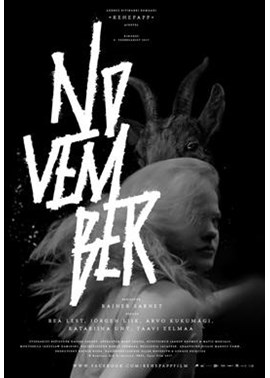
I had the good fortune to be invited to a film this afternoon by a thoughtful friend. Given my monastic tendencies and my obsessive desire for studio time , I was close to declining. But the film, November directed by Ranier Sarnet was only playing this one day, this one time (in LA!). If I had listened to that hesitant voice I would have missed a very great work of art.
I’m astonished.
I’m inspired.
I’m desiring in my art (and in my life) to be truer, braver, funnier, darker, richer.
Such is this fairytale masterpiece.
image from Homeless Bob productions . Link to their site below this image.
Living in LA I should be more of a film buff, everyone seems an expert. But truth be told my interest lies in the traditional arts. But this baroque gritty ravishing film , filmed exquisitely in inky black and blizzard white, is hilarious at moments, horrifying the next; it captures the essence of why fairytales are so essential. A primal confection, one moment a fantasy of alabaster lovers exchanging love tokens in a gilded gondola, the next, scatalogical buffoonery.
Not since Cocteau’s La Belle et la Bête have I swooned with such delight.
This preview only hints at the snow bleached beauty of this film,veined with the greed, rapacity, and wretchedness of base man and yet tenderly evoking the poetry of illusive desire and tragedy of ephemeral youth.
This link provides the dates this marvel will be shown.
After having seen this nourishing film, I feel impoverished after populist fare such as the Shape of Water (which I enjoyed). Whereas that aquatic romance delighted , this film lingers in the way a Bruegel painting haunts your memory . In fact, Bruegel with his potty-mouthed humanism is what came to mind consistently during this gorgeous film.
Cocteau had the handsome Jean Marais as his Bête; Sarnet has the beguiling Estonian actor Jörgen Liik as the comely Hans. I’m rather smitten by this flaxen crowned Apollo. I imagine I will be drawing him.
Jörgen Liik as Hans
I think I’ve gushed enough about this film. If you don’t believe me , read this review:
Lastly, thank you Lezley for inviting me. What a gift.
From left to right: Lilith the Mandrake, a St.Anthony drawing, The Magdalene and The Wodewose, awaiting admirers.
I have the good fortune to be included in a group show curated by my talented friend Rachel Gibas , the opening reception, this weekend at Coagula Curatorial on Chung king Rd., here in L.A. I’m very pleased and look forward to the opening. I’ve been informed that the exhibition is opening earlier, 5pm, which is fortunate as we have tickets for Orpheus & Eurydice that very evening, so I may enjoy Gluck and the company of my art friends.
I have also received final word that my solo show at MOAH-Cedar has been officially scheduled with an opening scheduled February 23rd 2019. A little less than a year away, which on one hands seems the distant future, but I have much I wish to accomplish before that time I recognize my desires will always outweigh reality-that is the nature of existence after all, books that will never be read, new friends never to have met, new vistas never to be beheld…yet we strive forward. That, in a nutshell, is my “studio practice” (ugh, that is such a pretentious phrase), the blind optimism of reaching towards an un-climable wall.
All that said, I will be stitching, painting, drawing, sawing, glueing, cussing feverishly to fill this space-horror vacui.
St. Kevin & the Blackbird Oil on panel 12 by 12 inches
This is how I have been feeling of late.
Lost, ill at ease, not of my own society, but not unhappy. In fact delighted and productive.
I am seeing an analyst ( a Jungian, and such a fine match) who has been acting as my Charon in the Underworld of my existential ambivalence. One of the loveliest aspects of my treatment is his frequently suggesting music, literature and poetry (frequently German and French) that might shine light on my shadow inked path. Touchstones that he thinks will resonate with me.
And they do.
Charon Attic Ashmolean Museum, Oxford, UK
He recently sent me a link to Mahler’s Ich bin der Welt abhanden gekommen performed by Dietrich Fisher-Dieskau. It was extraordinary and I needed to share in gratitude.
By Friedrich Ruckert, set to music by
Gustav Mahler. One of Mahler’s 5 “Ruckert
Songs.
Ich bin der Welt abhanden gekommen,
Mit der ich sonst viele Zeit verdorben,
Sie hat so lange nichts von mir vernommen,
Sie mag wohl glauben, ich sei gestorben!
Es ist mir auch gar nichts daran gelegen,
Ob sie mich für gestorben hält,
Ich kann auch gar nichts sagen dagegen,
Denn wirklich bin ich gestorben der Welt.
Ich bin gestorben dem Weltgetümmel,
Und ruh’ in einem stillen Gebiet!
Ich leb’ allein in meinem Himmel,
In meinem Lieben, in meinem Lied!
==== English translation by Emily Ezust ====
I am lost to the world
with which I used to waste so much time,
It has heard nothing from me for so long
that it may very well believe that I am dead!
It is of no consequence to me
Whether it thinks me dead;
I cannot deny it,
for I really am dead to the world.
I am dead to the world’s tumult,
And I rest in a quiet realm!
I live alone in my heaven,
In my love and in my song!
Such terrible beauty.
My doctor also suggested I read Mary Oliver’s reflection upon Mahler’s magnificent Lied.
Ich Bin Der Welt Abhanden Gekommen
by Mary Oliver, from the House of Light
Today is
Gustav Mahler’s
birthday, and
as usual I went out
early into the sea-green
morning where the birds
were singing,
all over but mostly
at the scalloped edges
of the ponds
and in the branches of the trees,
which flared out and down,
like the clothes of our spirits
patiently waiting.
For hours I wandered
over the fields
and thinly thing that kept me company
was a song,
it glided along with my delicious dark happiness,
my heavy
bristling and aching delight
at the world
which has been like this
forever and forever-
the leaves,
the birds, the ponds,
the loneliness,
and, sometimes,
from a lifetime ago
and another country
such a willing and lilting companion –
a song
made so obviously for me.
At what unknowable cost
And by a stranger.
(I copied this by hand, trusting I made no errors).
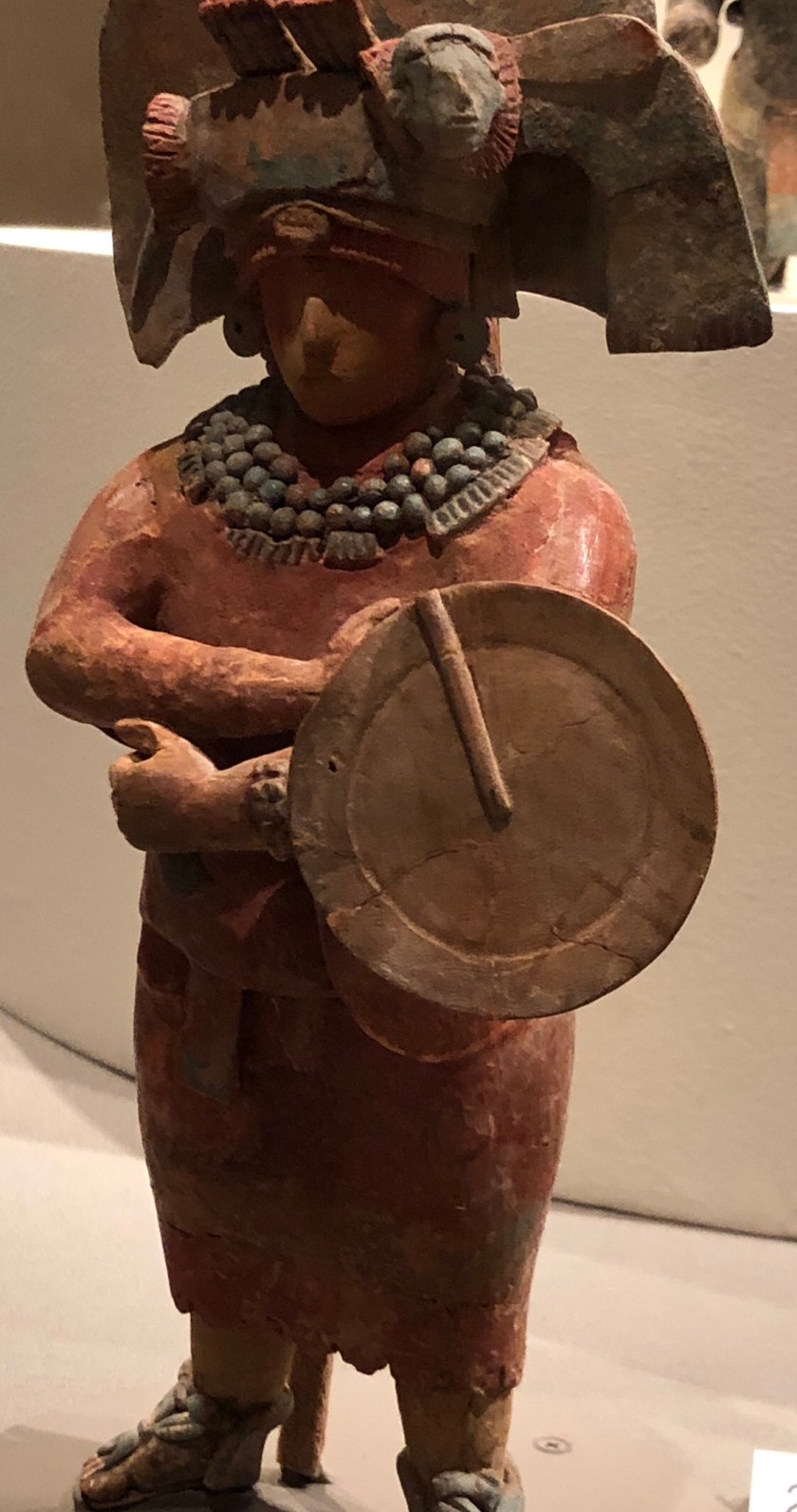
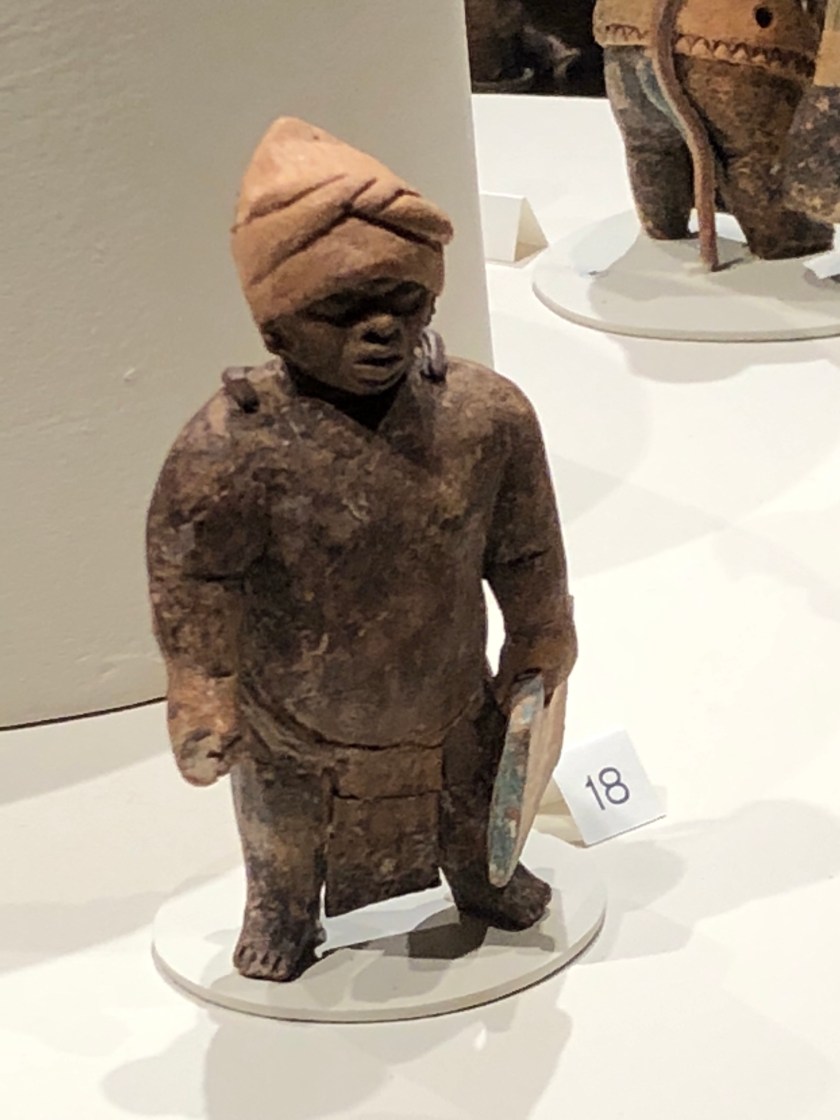
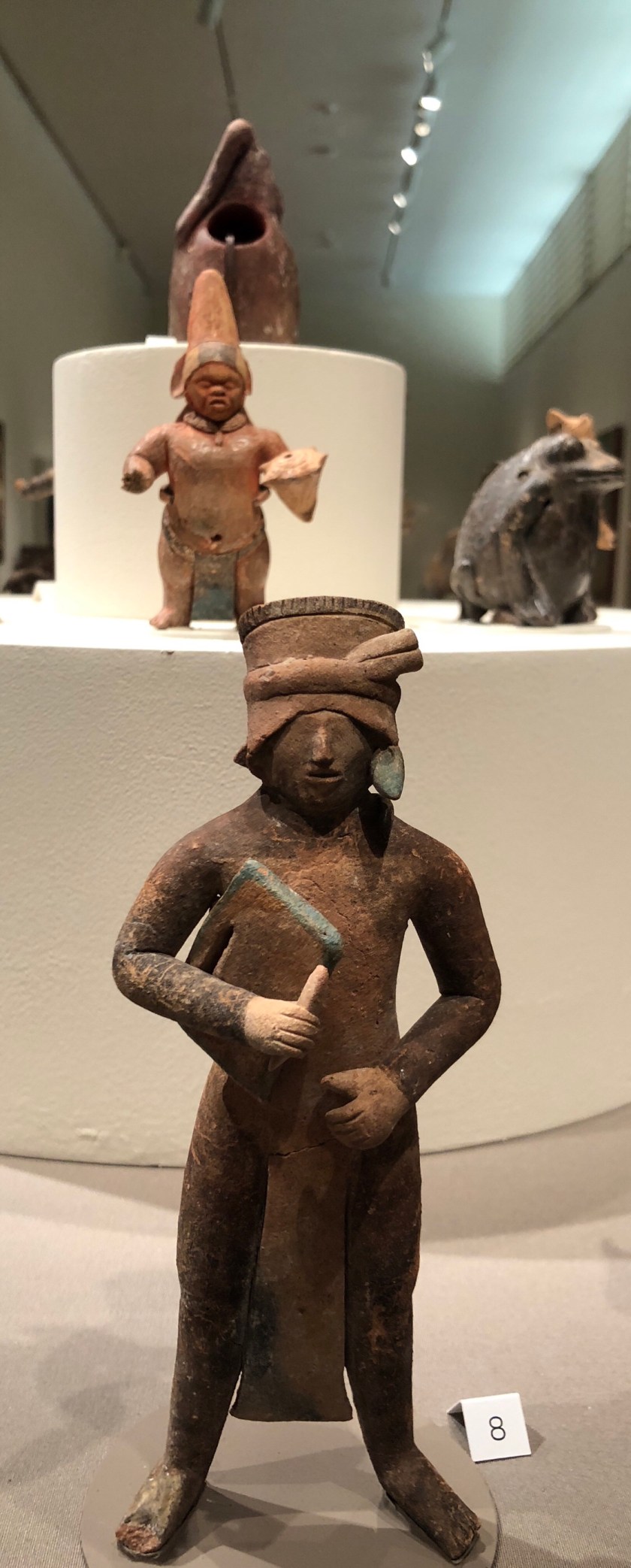
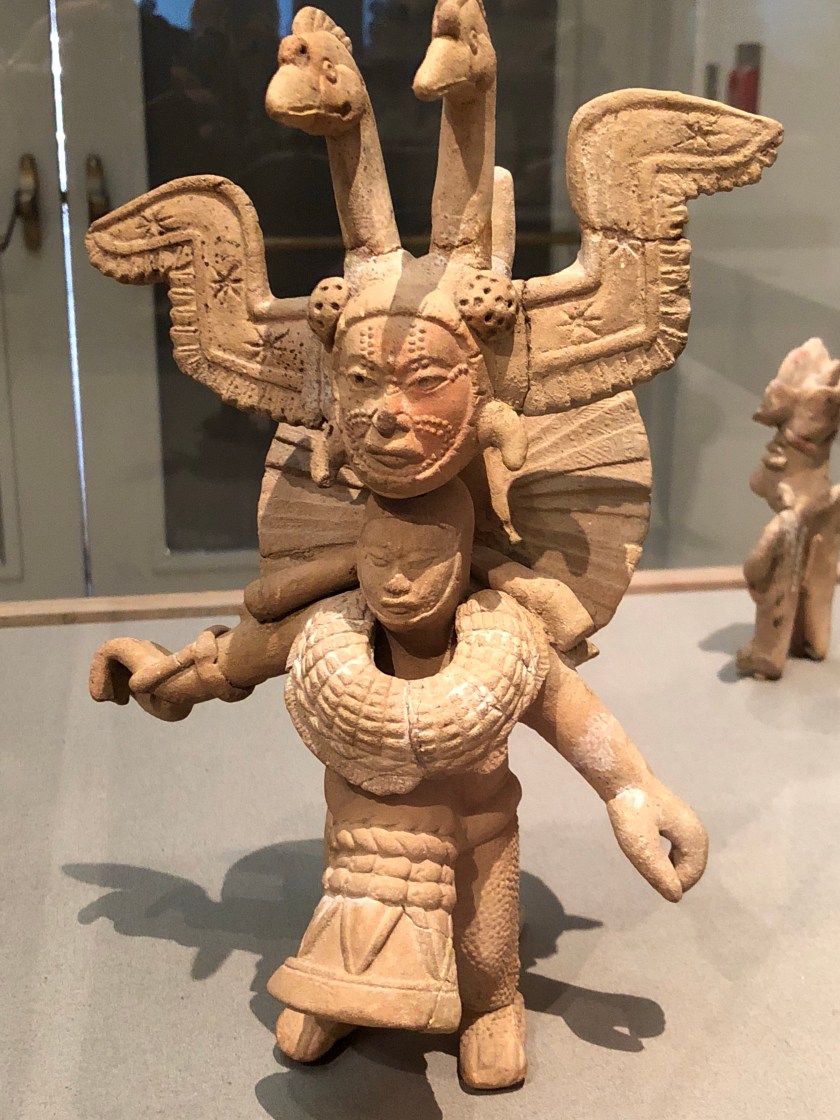
Last evening the Beloved and I went to LACMA to at last catch ” Ancient Bodies: Archeological Perspectives on Mesoamerican Figurines” , link: http://www.lacma.org/art/exhibition/ancient-bodies. A beguiling collection of figurines found near to dust at a ritual burial site in Guatemala, now restored . It is an extraordinary miracle that they have survived and that the shards of ephemeral clay , shimmering still with that iconic Maya blue , were able to be restored to their imaginative theatrical splendor . The attention to detail , the costumes , the inherent ritual of the funerary drama , all deeply moving and inspiring.
Here are some snapshots of these diminutive masterpieces. The show closes tomorrow February 4th, you literally have only hours to see this before they are returned to the vault, for how long , I haven’t a clue.
For a sense of scale, my husband gazes in wonder.
The following were not found in the aforementioned burial site but are part of LACMA’ current holdings of Maya ( Mesoamerican in general ) art . A testament to the richness of their treasure rooms . It’s a wondrous collection in a dazzling suite of gorgeous galleries , 4th floor of Art of the Americas Building.
My surname is Greco, my paternal grandfather fiercely proud of our rich heritage; clearly my roots are Italian, but in all honesty I’ve only just begun to recognize and appreciate the impact my cultural patrimony has had on me,as an artist and in many ways as a gay man.
I was inspired to reflect upon this existentially while submitting to a group show exploring and celebrating the Italian diaspora. I am the offspring of Calabrians who fled the poverty of their region for the fabled bounty of the New World. Setting sail in the teens of the early 20th century, my great grandmother came armed with a cheap gilded ring set with blue glass (which I now treasure ) and a feisty spirit. Incredibly small people and brown as a nut, my great-grandparents were frequently met with bigotry and prejudice.
Yet they persevered, settling in Trenton N.J., they were embraced by fellow immigrants (many from Naples) in the Italian American enclave known as Chambersburg (colloquially known as the ‘Burg). It is there that they opened water-ice parlors, manned grocery markets and in the twenties, my grandfather, as a boy, ran rum for the mob. Ultimately the family prospered enough to move to the suburbs, sadly leaving the cultural richness of the ‘Burg behind for the homogeneity of the NJ suburbs. My grandfather never felt like he quite fit in with his “white” neighbors, but the pride in his hard earned prosperity was palpable and difficult not to appreciate.
For me, as a sensitive queer boy, artist wanna-be, the suburbs were an aesthetic hell. Cultural deserts where “Mediterranean” evoked cheap flocked wall coverings and abominations upon inky velvet graced many a family room. My boyhood salvation was mass at the family church back in Chambersburg, Immaculate Conception, a 19th c. Gothic Revival pile, redolent in incense, ritual and gilt. It was heaven, and to this day I remember gazing up at its painted ceilings in wonder, and knowing one day, I too would be an artist. My grandfather assured me that was absolutely possible for Italians were especially gifted artists ( although he also insisted that the Irish were particularly gifted in depicting angelic hosts- where or how how he came to this opinion is something I still think about).
So now, in submitting to Italianitá, hosted by the Italian American Museum here in LA, I put to paper the influences my heritage has had on my art and my identity. This is what I came up with:
Leonard Greco
Artist Statement
As a child of Italian-American descent (my paternal great-grandparents arriving from Calabria in the early 20th c.),I was raised in the culturally impoverished suburbs of NJ, yet it was my Italian roots that nurtured my aesthetic and acted as a balm to my artistic soul. Be it the street theater of Feast Days, the Madonna paraded and joyously lauded, the Festival of Lights, or the gilded grandeur of my parish church, it is clear to me that these influences decided my fate to be an artist.
In my work I explore the extremes of human existence through the presentation of archetypal figures undergoing transformation and experiencing salvation, rebirth and enlightenment; not unlike the art of Rome, be it sacred or profane. My paintings are self-contained narratives concerned with universal themes—birth, life and death— that stem from my personal experiences and passions. These include my love of classical mythology, Roman Catholic saints, the Italian Renaissance and Baroque, as well as the commedia del arte , low brow erotica and Surrealism.
As a queer artist my work frequently reflects a sensuality not unfamiliar to Italian art and culture. In this work I am searching to find the divine in the everyday, to show that all life, in all its incarnations is indeed sacred and beautiful. The works are metaphors that explore human relationships and interactions from myriad points of view and ultimately are about my understanding of my place in an ever-changing world.
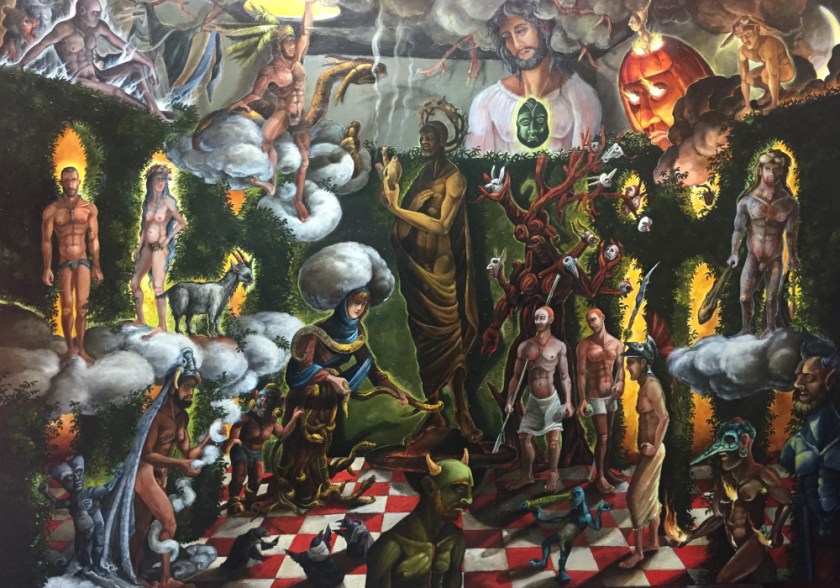
Seizing Sanctimonium 2016 oil on canvas
My oil painting Seizing Sanctimonium is an allegorical homage to personally well loved artists such as Mantegna and Poussin and also a psychological exploration of my own spiritual and existential angst. Employing Renaissance compositional techniques such as one point perspective and borrowing freely from the drama of the Baroque stage, my intention was to evoke the tensions that arise between powers. In this instance, the Roman Church here being confronted by the Old Gods. This tension is palpable in ancient cities such as Rome and Mexico City, where timeless allegiances are everywhere, the old gods literally arising from the earth. Attempts to integrate the old ways into the orthodoxy of Christian faith creates a tension that is complicated, painful yet often dazzlingly beautiful. As a gay man, a artist and a Roman Catholic these tensions are personal, familiar, and frequently painful; conflicted by dictates of the Church and personal truths (embodied here by the Old Gods), it is in my desire to express this pain and to synthesize the diverse elements of my being. It is my hope to create work in my own voice, my own purpose and my own understanding of beauty.
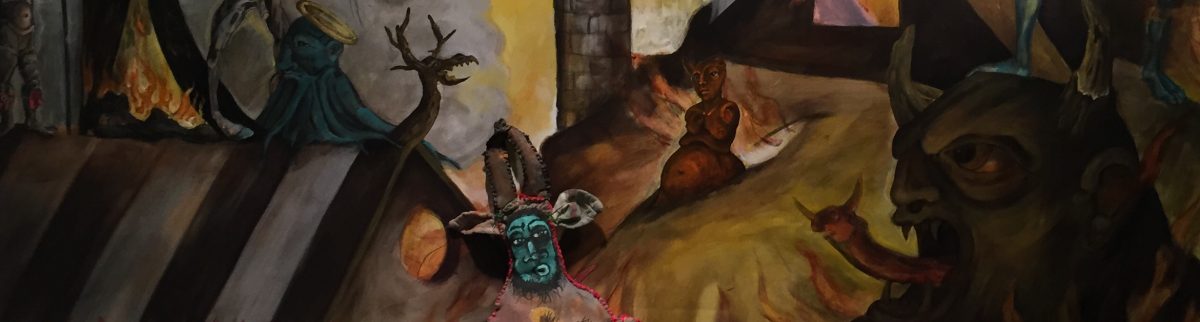
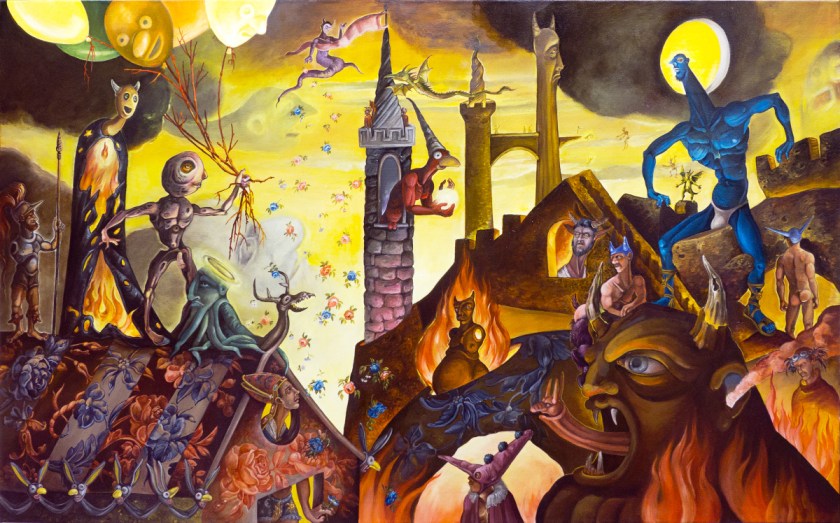
Hadesville 2016 oil on canvas
My oil painting Hadesville is yet another homage to works of art that have influenced and inspired me. In this instance the Hellmouth warnings found in late Medieval and early Renaissance churches. These fantastical works are frequently the most inventive, adventurous, not to mention humorous works of art found in Christendom. Mostly attributed to anonymous artists, they continue to beguile , I am not alone in my appreciation. My painting Hadesville recalls such works, employing universal elements such as the aforementioned Hellmouth and symbolism that is personally meaningful.
In addition to the High Medieval, I also nod to Dante and his Divine Comedy with my own oddly disconcerting guides found in the upper left portion of the composition. Navigating the complexities of life, spirituality, sensuality (and the Underworld) was enthusiastically explored by the Italian masters of quill and brush,my humble aim is to add to that conversation.
Daphne 2018 Mixed media/fiber art
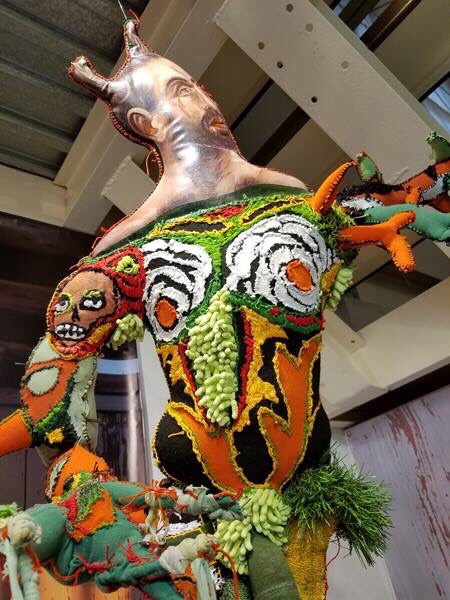
Daphne is part of a new body of three dimensional work that I identify as Stuffed Paintings. These painted and stitched figures are intended to evoke the dramatic presence of Baroque theater and sculpture (most specifically, as in this case, Bernini). These pieces, Daphne included, frequently explore the power of transformation, sacrifice and redemption . Ovid’s Daphne,suffering divine injustice and paternal betrayal, ultimately finds “salvation” through metamorphosis (in her case, that quintessential symbol of Classical triumph and victory,the laurel bough).With that in mind, the theme of Daphne felt ripe for personal reinterpretation.
It is in this framework I wished to create my own response to Bernini’s ravishing marble masterpiece. In exploring the challenges presented in life, be it familial discord, conflicts with identity or romantic entanglements, my intention was to document the turmoil and anguish necessary to personal development. In so doing, I not only shift mediums from solid stone to pliant fabric, but I also swap gender, making this embroidered and painted allegory my own.
In closing, my grandparents.
Tommy & Mary (anchorbabies?) 2017 oil on panel 8 by 8inches
Lilith (the Mandrake) was nostalgically inspired by memories of my own youthful desire and identity struggle in the reign of disco.
By incorporating discarded elements of sartorial seduction current to the period (late 70’s early 80’s),the ubiquitous Izod shirts, which seemed mandatory for young gay men, the neon “New Wave” colors found at Fiorucci (and elsewhere) and the general “clone” aesthetic raging in NYC at the time, I tried to playfully examine the entanglements that were ahead of me.
The Harrowing of Hell 2018 Sanguine pencil, white charcoal, toned paper 24 by 18 inches
The theme of the great Harrowing of Hell, that period in time in which the Church seems to hesitate a bit, unsure of what really happened, that time after Christ sheds the mortal coil and isn’t seen for a few days. Where he is said to have descended into the Underworld as a triumphant New Adam and liberates lost and languishing souls- that, that moment , fascinates me.
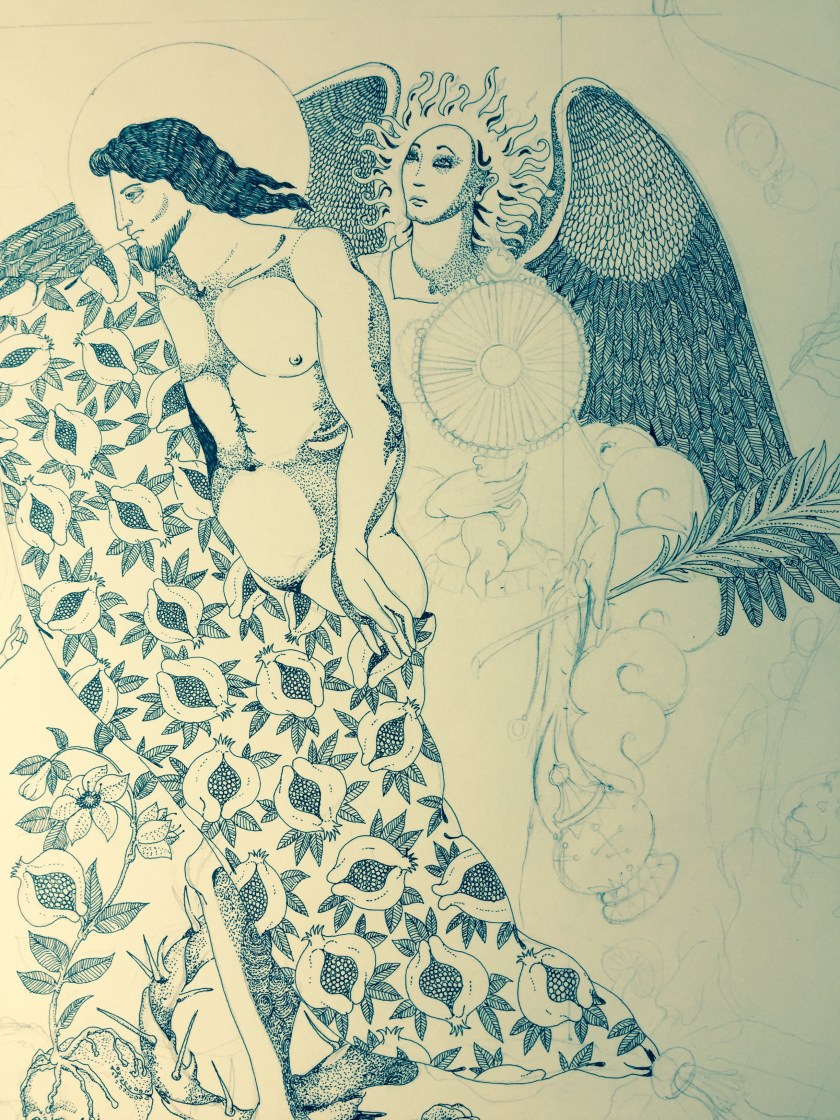
It has for quite some time, as a youth I placed ink to paper in an attempt to imagine such a mythic moment ( the use of pomegranates as a decorative motif, seemed at the time, a brilliant allegory and subtle reference to Eurydice)
Youthful stab at a subject too grand…(1980-81?)
As the first(and latest) image attests, the theme still beguiles. Having only recently listened to George Saunder’s astonishing Lincoln in the Bardo (thank you Audible, now I must actually read it). I have been taken with the in-between time of death, redemption and the ambiguous souls left floundering; the Bardo as Saunders asserts. Death isn’t always with me in a dismal way, but it is endlessly fascinating. I don’t actually want to know for sure what the path ahead holds for me, but I am darn curious.
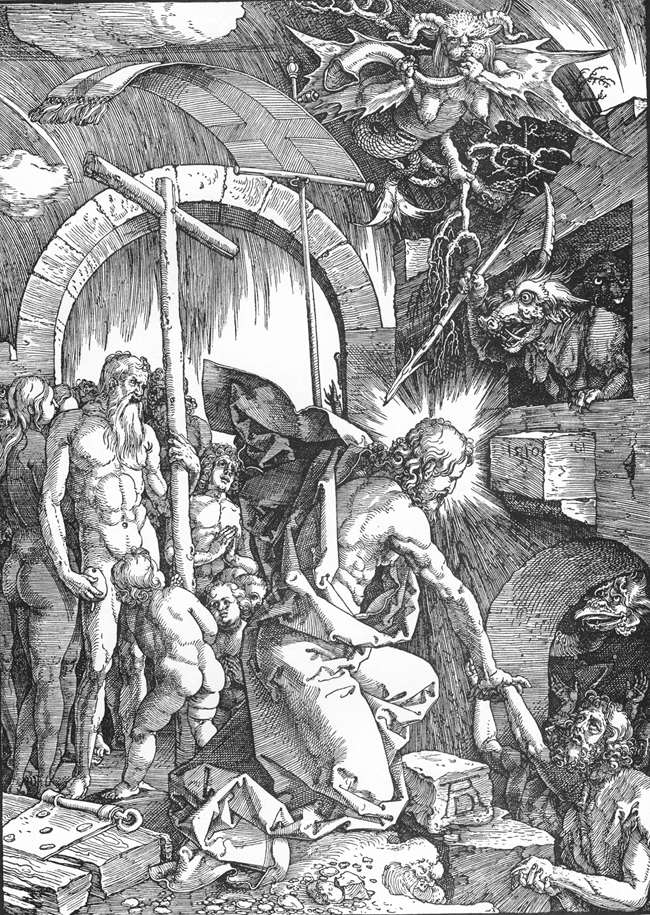
The first introduction to the theme of the Harrowing was Albrecht Dürer’s spectacular depiction of it (Dürer is a heartthrob figure for me in so many ways).
Albrecht Dürer Descent into Limbo
One can easily see Dürer’s influence on my work, going back to my teens. Clearly I stole from the Master in this youthful depiction of the Fallen Adam.
Unfinished drawing of Adam and fallen Bishop of Rome.
What I had failed to comprehend was what was meant by Hell. In time I came to realize not so much the eternal fires of a wrathful God, but a waiting station, the vague Limbo of my youthful Catholicism.
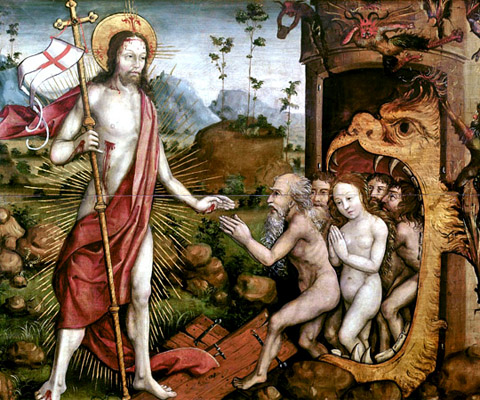
The theme has been explored countless times; the following, are a few favorites.
The ubiquitous follower of good old Bosch.A lovely example from 1504.14th century Petites Heures de Jean de BerryA gorgeous depiction of the Harrowung of Hell, only vaguely attributed as “Renaissance”. Lovely nonetheless.
My own inspiration was more random, less planned; in my last studio move, an accidental composition made itself available to me. I suspect I will returning to theme again. Perhaps next time Christ will be more triumphant, more muscular in spirit, less hesitant. Although, truth be told, hesitancy seems a reasonable stance.
The Harrowing of Hell 2018 Sanguine pencil, white charcoal, toned paper 24 by 18 inches
I’m very pleased that two of my favorite and decidedly not “family friendly” paintings have been included in this exciting group show curated by the talented Gwen Freeman.
Show details follow:
“Family Friendly” is a loaded phrase for those who do not conform to the hetero-normative model–the paradigm often described as “normal,” “just regular,” or “traditional.”
This phrase, “family friendly” can be interpreted by the LGBTQ community as code for “not including me.”
But, of course, gay, lesbian, transgender, non-gendered, gender-fluid, cross-dressing and queer people are very much a part of families all around the world.
This exhibit seeks to explore that fact, and to celebrate a broader more inclusive definition of family.
PARTICIPATING ARTISTS:
Joanne Chase Matillo * Natalie Egnatchik * Michael Frey * Leonard Greco * Kerry Thorne
CURATOR:
Gwen Freeman
LOCATION:
The AAC Blue Wall Alcove @ Ave. 50 Studio
131 N. Avenue 50, Los Angeles, CA 90042
EXHIBITION DATES:
February 10 – March 3, 2018
OPENING RECEPTION:
Saturday, February 10, 2018, 7 -10pm
Herakles & Telephos 2015 watecolor on paper 12 by 9 inchesThe Castration of Uranus 2015 watercolor on paper 11 by 14 inches
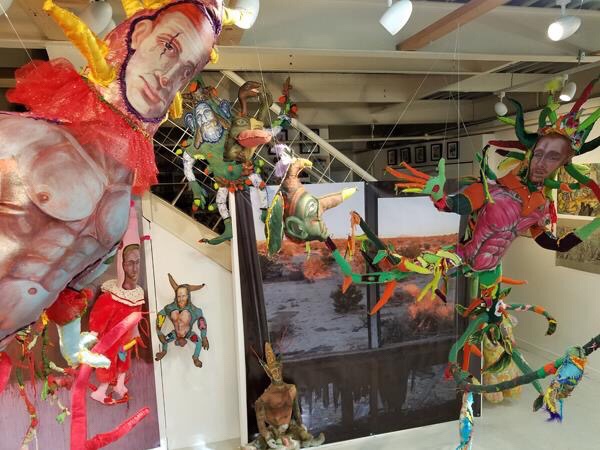
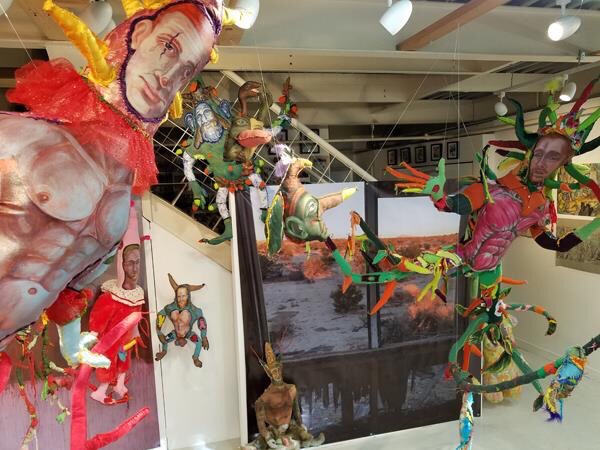
Last evening’s reception for Embodied:St.Anthony & the Desert of Tears was gratifying in many ways . Most especially in the support shown by my wonderful friends and fellow artists . The art community in LA is a generous one , I am exceedingly grateful for that .
But also in where this residency has brought me , I feel as if I am on a landing , creatively speaking , and about to ascend with a stronger conviction and more focused intention.
I thank Kristine Schomaker and her ShoeboxProjects, which offered this residency to me . I also thank Kristine for these marvelous images . Amidst the hubbub I didn’t take one image . So again, thanks Kristine!
With that said , let the mayhem be fondly remembered.
I love this image of Kristine, really working my hat .
My friend , the excellent photographer Stephen Levey took these images , I particularly like the one with my talented friend Bibi Davidson and our demonic love child .
Our wonderful friend Jodi Bonassi , another great artist , was working the hat as well !
Always lovely to see my friend Randi
And miraculously , our dear Malka Nevidi , yet another amazing artist, arrived near closing . Thank goodness. But all good things must end , we’ve packed it all away , down to the crisp white walls , ready for new inspiration. Filled with much gratitude… and now, a head cold .














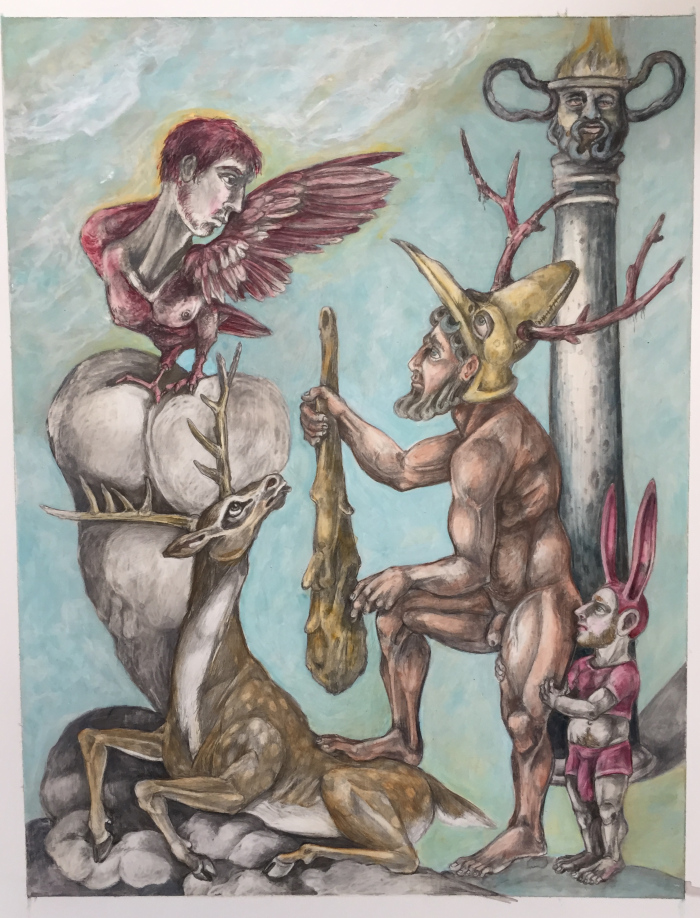








 But all good things must end , we’ve packed it all away , down to the crisp white walls , ready for new inspiration. Filled with much gratitude… and now, a head cold .

 Boondocks Babylon