“H” is for Hun Hunahpu, the Maize God

In my imaginings, Hun Hunahpu is the Zeus of the Mesoamerican Olympus. There doesn’t really seem to be one supreme deity, various cultures favored one god over another; but it is undeniable that Hun Hunahpu is a major player of the Popol Vuh.

Without Hun Huahpu , man would languish without nourishment; for it is with his sacrifice and redemption that he brought forth maize, teosinte to native people. Teosinte translates as teo, godly or sacred and cintli which translates as maize= godly corn.

It is this godly corn from which man is fashioned to serve the gods. Ancient teosinte was apparently tri-colored: golden, red and blue. Native people saw the similarities in their own lovely golden bodies, rippled with blue veins and able to release radiant red blood when cut.

This imagery is very rich to me, which is perhaps why I have fetishized Hun Hunahpu, a pagan Savior for New Spain.

“H” is for Hun Hunahpu
watercolor on paper
18 by 11 inches

Clive was (is?) working on a particularly fetching Gawain, I was enchanted by the fair knight’s porcelain skin; this motivated my own pale radiant god. I tried to capture the tri-color palette within the limitations of the Primer palette. I failed to keep it monochrome with only one color. The siren call of  my paint box gets me every time. I did want to capture the veining that  Mesoamericans read as blue, and the golden quality of my god is apparent .

What is also apparent  is the homoerotic nature of the painting. I may make another more chaste version, I may not. I know I wanted the Maize God to look physically and sexually striking  , he is after all a fertility god! The “subtly” placed corn cob may be a bit excessive, but I couldn’t resist the visual pun.

I appreciate the indulgence.

I am finishing up a painting in oil, another bit of male pulchritude, I will present him next week, the gods willing.

Until that time,

take care,

LG

“G”is for Gold

It isn’t an original thought to believe that New Spain was built upon a foundation of stolen gold; the Spanish lust for what the Aztecs called teocuitlatl is infamous. What is perhaps less known is the Aztec belief that gold was the excrement of the gods; although of value, gold paled next to the luster of jade and the sparkle of the quetzal feather. That said, what was wrought by the Aztecs was of such wonder that the great Albrecht Dürer (the son of a goldsmith) exclaimed upon seeing the golden booty:

“Also I saw the things which were brought to the King from the New Golden Land: a sun entirely of gold, a whole fathom broad; likewise, a golden moon, entirely of silver, just as big ;likewise, sundry curiosities from their weapons, armor, and missiles; very odd clothing, bedding, and all sorts of strange articles for human use, all of which is fairer to see than marvels. These things were all so precious that they were valued at a hundred thousand guilders. But I have never seen in all my days that which so rejoiced my heart, as these things. For I saw among them amazing artistic objects, and I marveled over the subtle ingenuity of the men in these distant lands. Indeed I cannot say enough about the things which were there before me.” (source:Mary Ellen Miller’s The Art of Mesoamerica). 

Alas these “artistic objects” that so thoroughly enchanted Dürer were melted down for the crass value of their base metal.

With that in mind I present “G” is for Gold; the acclaimed metalwork rendered in my own particular  Babylonian Baroque style.

“G” is for Gold
18 by 11 inches
watercolor on paper

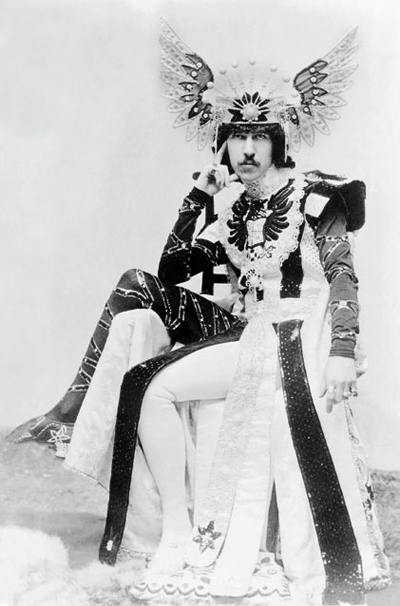
My figure of the enthroned Motecuhzoma II was based upon a sketch from a recent life drawing session. The young model was particularly louche , this suggestive pose seemed appropriate for the last Emperor of Tenochtitlan. But upon completion I realized with the addition of an obviously camp head-dress the emperor now had a closer affinity to  Henry Cyril Paget, the 5th Marquess of Anglesey (the notorious “Dancing Marquess”) than a noble King.

Oh well.

The Dancing Marquess – Henry Cyril Paget, 5th Marquess of Anglesey

I am now back home from a far too brief holiday, busily catching up, posts to follow.

Until that time,

take care,

LG

“X” is for Xquic

Progressing forward on the Primer of New Spain.

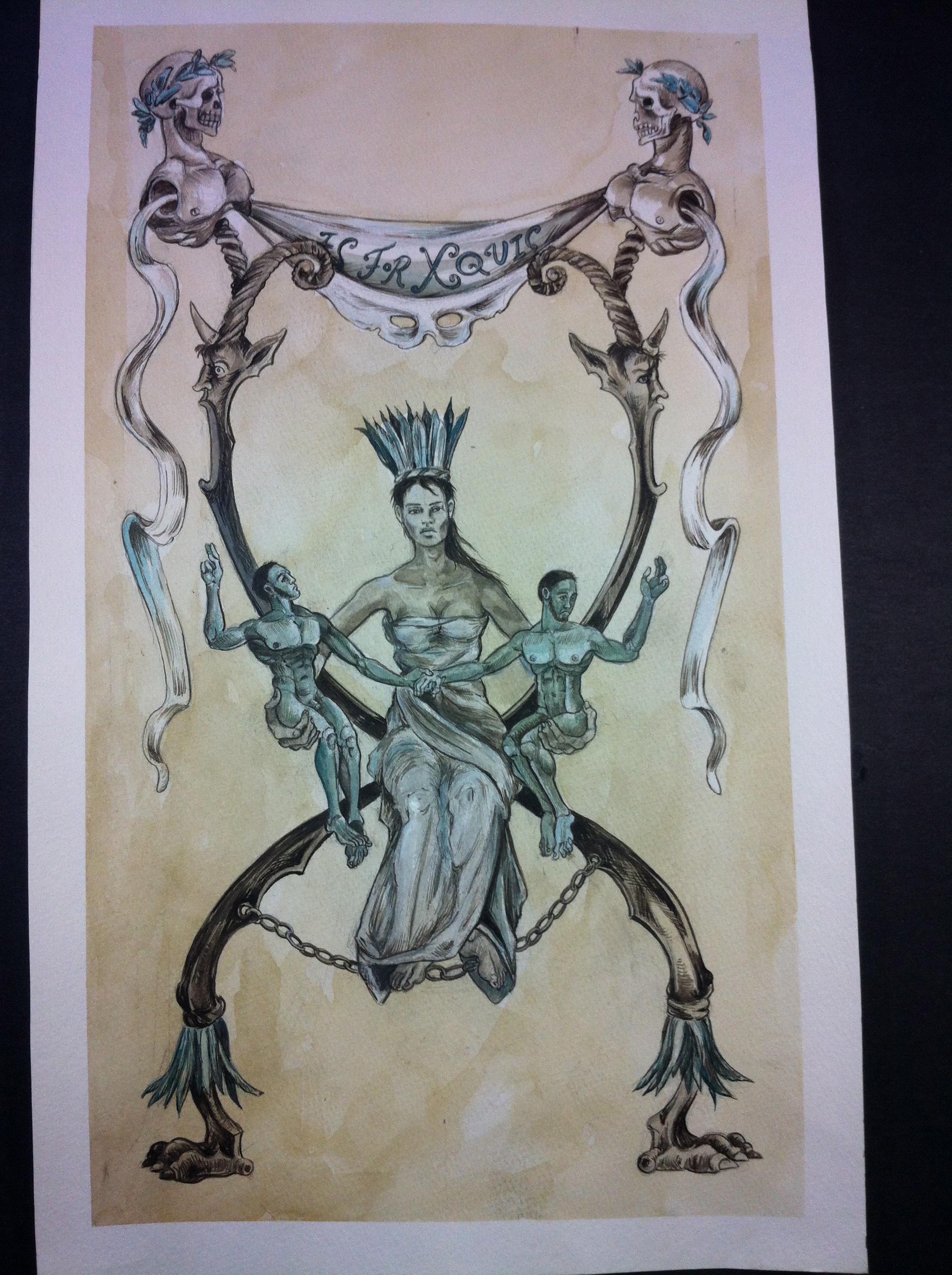
As I mentioned last time I will be jumping about the alphabet. As I began with “A”, “X” seemed the logical choice. I chose Xquic, the princess of Xibalba. For those who have followed this narrative , and not been daunted by the tongue twisting names, you will remember she is the heroine of the Popol Vuh narrative. Having miraculously given birth  to the Hero Twins, I present her enthroned upon an “X” chair.

“X” is for Xquic
2012
watercolor on paper
16 by 20 inches

The following is a detail (as the image is rather small) of Xquic and her sons the Hero Twins, Hunahpu and Xbalanque. As I progress in this series I continue to paint the Twins blue. There isn’t  a tradition for this, I just like the effect, an homage to Clive Hicks-Jenkins.

detail of Xquic and the Hero Twins

This may be the last post for a bit, trying to tie up loose ends as we are leaving for a brief Independence Day holiday. We are going to Portland Oregon, it seems such a pretty and progressive place; far different temperament and climate from oppressive San Diego. We are both excited to get out of Dodge.

Until next time,

take care,

LG

“A” is for Axis Mundi

As is consistent with my temperament , when faced with a rather daunting task (in this case an alphabet primer), I start at the beginning and soldier on. Hence, “A” is for the Axis Mundi.

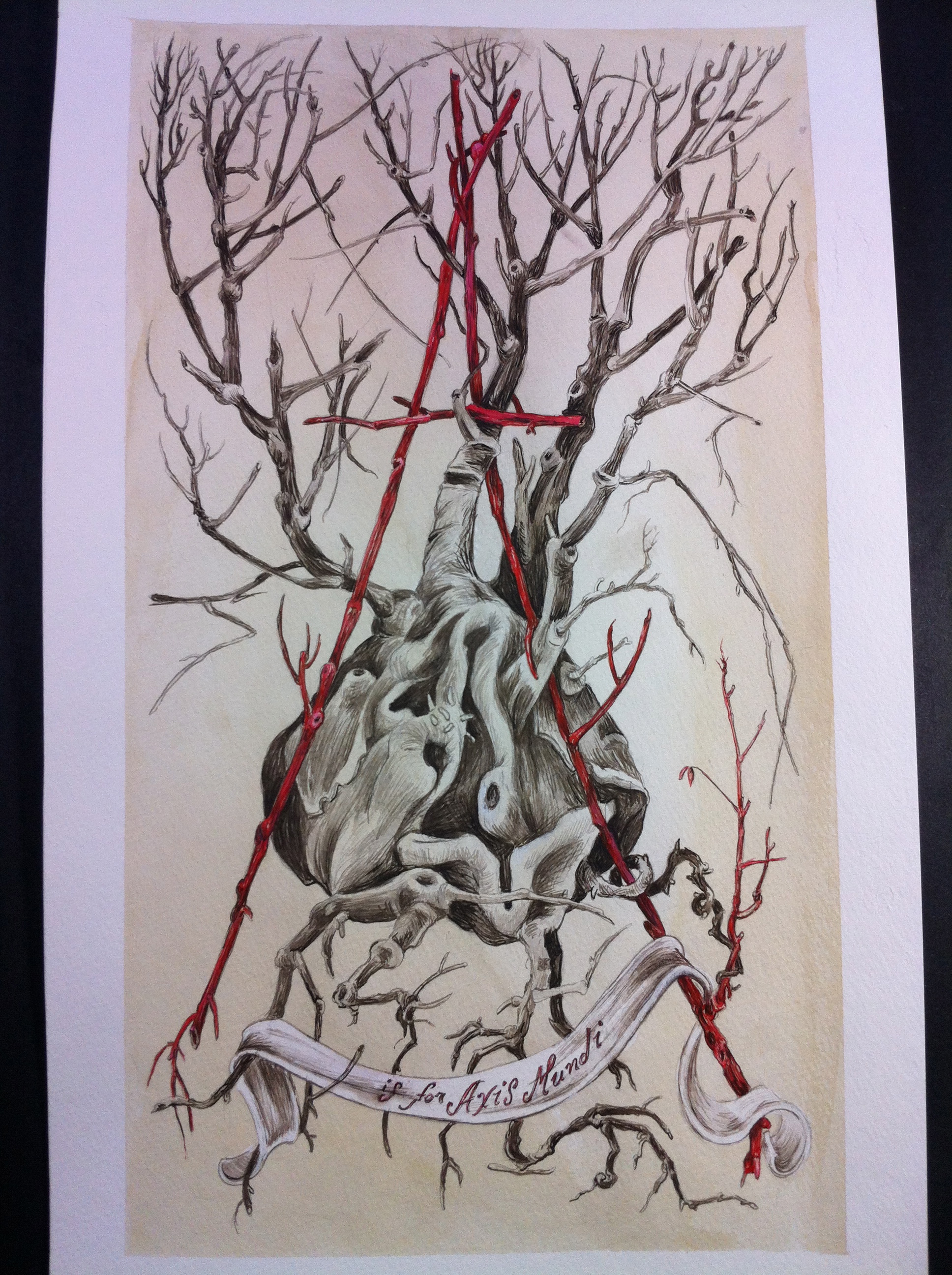
In Mesoamerican culture, the Axis Mundi, essentially the World Tree, is  situated at the center of the Earth. It is truly a  cosmic being, with its branches kissing Heaven and its roots finding their way to the bowels of Hell. Traditionally the World Tree is thought to be the glorious Ceiba tree, the link provided is well worth a glimpse or two. I remember this beautiful tree from our time living in Ft.Lauderdale. It is a perfect tree for me, close to nude save for ferocious thorns;instead of pedestrian foliage , the Ceiba rewards visitors with fabulous orchid-like flowers, often hot pink. It is quite simply a stunning tree, no wonder it is the national tree of modern Guatemala.

All that said, I did not depict the fantastic Ceiba, I chose instead an odd little tree that we have fallen in love at the Cactus Garden of Balboa Park here in San Diego. I don’t know what this curious specimen is, we haven’t located an identification plate, but I will research further. What is apparent is its great age, probably pushing a century mark, which is curious as it is a very tiny little tree.

This is my interpretation of the odd little charmer.

“A” is for Axis Mundi
June 22nd 2012
watercolor on paper
9 by 16 inches

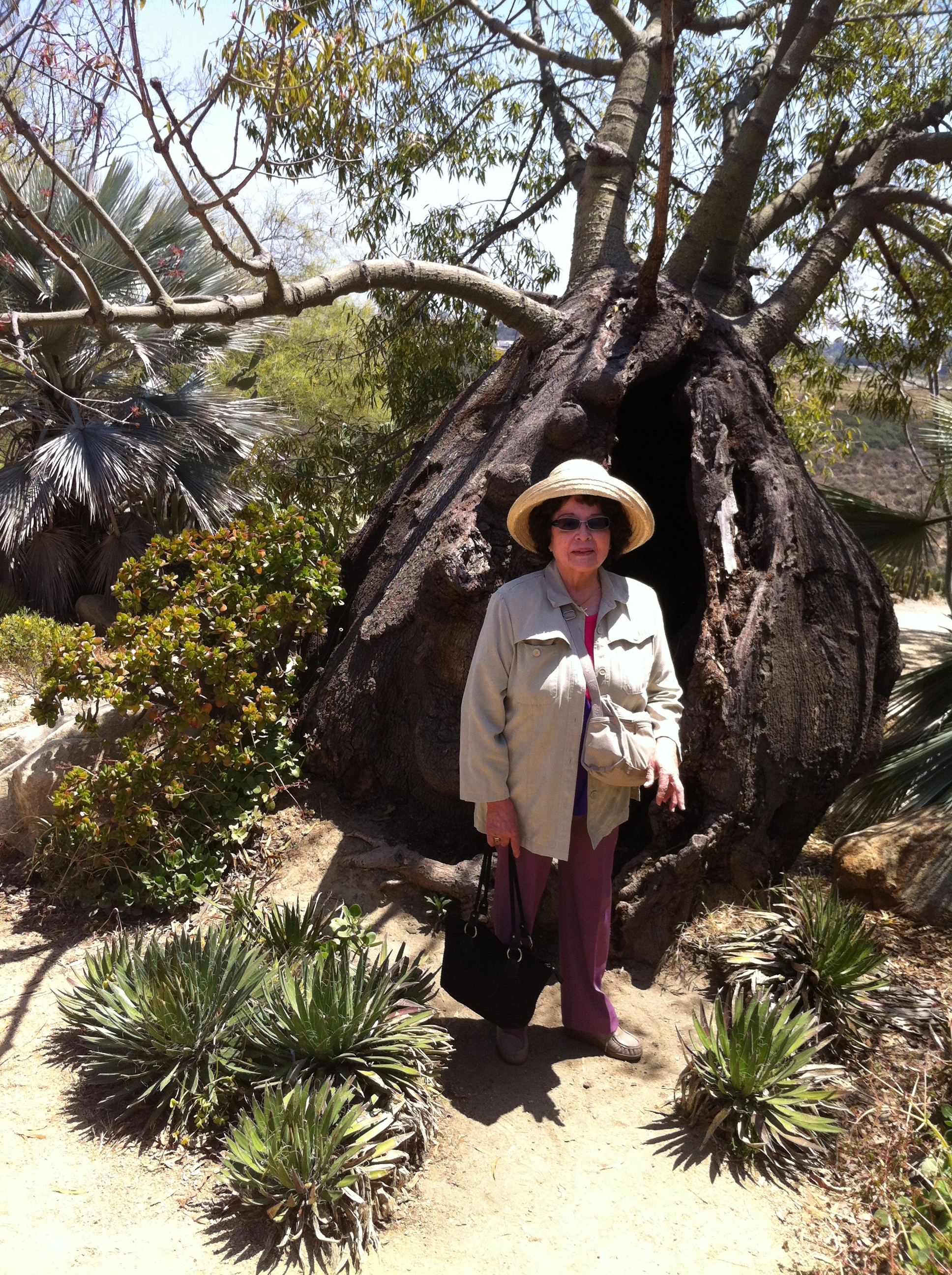
And this is the tree as we know it.

Axis Mundi @ Balboa Park, San Diego

To give a sense a scale, here is the dear tree with David’s equally dear Aunt Lydia, a wee little woman, 5’2″ or so.

Aunt Lydia @ the Axis Mundi

I’m working through the alphabet, I think I will be more random than my initial inclination if for no other reason than aesthetics. Given the scope of the endeavor, there is bound to be stylistic progression as I delve forward. I think the primer will possess a more consistent aesthetic if I jump about. That said, “H” is drawn out, Hun Hunahpu, the Maize God. I will present that when complete.

I think this will be a fun ( and exhausting) project, I have been fantasizing about the frontispiece. My conceit is a primer of New Spain to be presented to Charles V, I want the frontispiece to be full of that overblown false modesty and groveling  found in  period documents.

Well until next time,

take care

LG