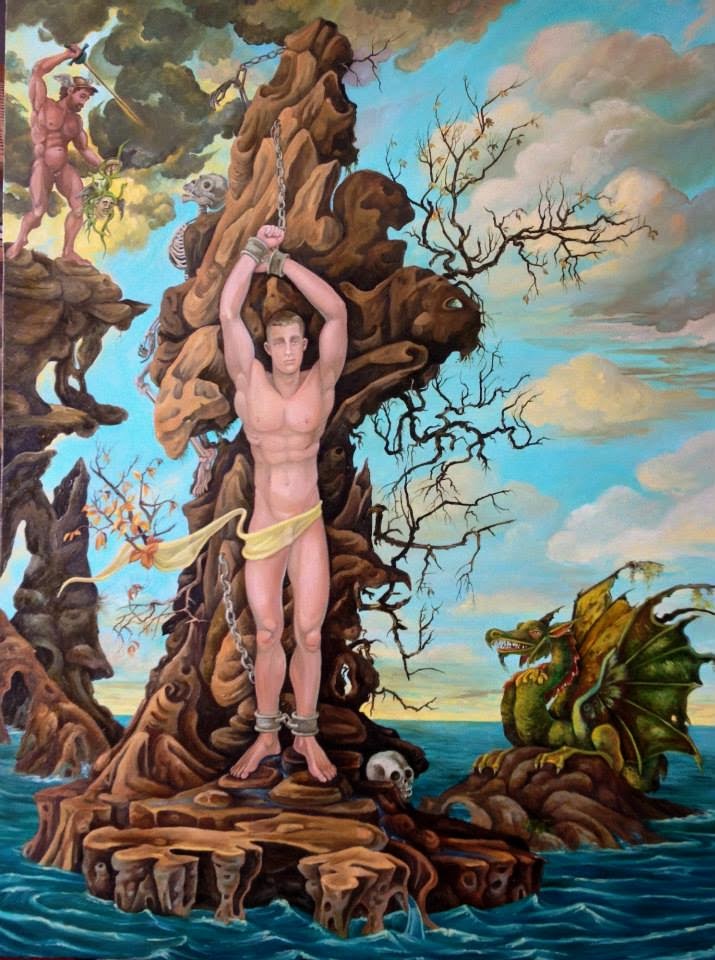
The wonderful art blog fullfathomfive ( link HERE, )recently featured my work; please check it out. It is an incredible site, I’m in lofty company.
Thank you Thom!
The wonderful art blog fullfathomfive ( link HERE, )recently featured my work; please check it out. It is an incredible site, I’m in lofty company.
Thank you Thom!
In my ever expanding collection of books , I possess a well worn volume that I treasure dearly. It is The Odyssey of Homer, translated by Alexander Pope and illustrated with lovely line drawings in the manner of Flaxman. As I mentioned, it is in sorry shape, but I picked up this gem for a quarter at the Carnegie Library in Pittsburgh many years ago. I confess I haven’t read this translation, the pages are brittle, the text so teeny I can barely focus on the page. I merely enjoy the book ; its fussy attention to detail, each page framed by an elegant red line, its many musty charms. I particularly love the ornamental spot illustration, micro plates , somewhat Greek (sometimes not) in nature,that intersperse the text; they are often enigmatic and always delightful .
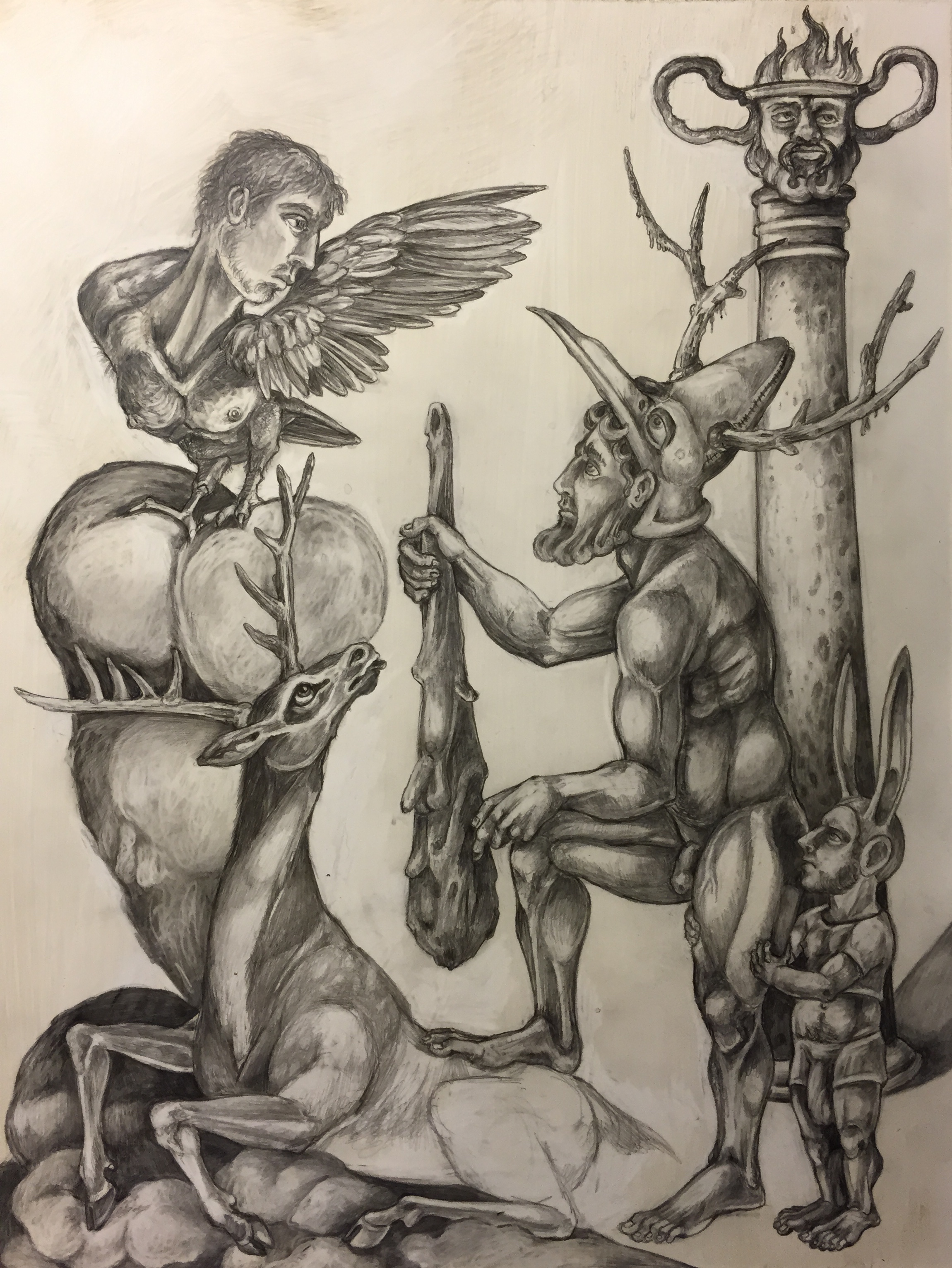
One such micro plate inspired this painting/drawing, Herakles and Telephos.
Herakles and Telephos
2015
graphite and watercolor on YUPO paper
9 by 12″
Initially when I stumbled upon the plate (set neatly between Book XIV and Book XV) I couldn’t figure out what the hell I was looking at. The image seemed vaguely surreal in its composition and in its elements: a big headed man, a putto, a doe (with antlers), a strangely phallic cloud and a menacing raptor. But as I began working on my own interpretation I began to realize I was looking at an image of Hercules and his infant son Telephos. In a nutshell, Telephos born of one of Hercules’ many dalliances, was ill fated, and like the babe Oedipus, sentenced to death, in this case by his fearful maternal grandfather. Our Hero-daddy rescues the boy, entrusting his care to a lactating doe. For a better explanation, this link might help, HERE.
The following is the initial image, blown up quite a bit, the original is the size of a postage stamp; I have no clue as to who the artist was.
If the original was enigmatic, my interpretation might be more so. I of course retained the phallic cloud, and the doe’s perplexing antlers, but Telephos is no mere babe and the raptor/Zeus ( the boy’s grandad) is no mere bird. I’m not going to analyze the drawing to deeply but let’s just say the notion of a protective father figure resonated for me. Session ended.
In this drawing/painting I experimented with a new material, the synthetic paper YUPO ( link HERE). I was introduced to this paper by another artist who extolled its virtues, namely its ability to take a lot of medium and still remain flat and unwrinkled. It also allows for errors in watercolor to be easily removed. Alas it also allows for details you value to be easily removed. It takes a bit of time for paint to set up, and I must figure out how to work with it. YUPO may not be my go-to paper just now but it does have possibilities I would like to explore. It is marketed as a watercolor paper yet it takes graphite beautifully, the pencil glides upon the smooth surface. The following is the drawing before I added watercolor.
Today I will be back into the thick of oils and perhaps venture into a hand puppet ( one idea will not leave my head so I better let it out).
Be well,
Lg
Last evening I completed a small painting, I like to think of it as an icon, an icon to a dreadful god. Once again, the great war god of Tenochtitlan has captured my imagination, this time expressed in oil.
The Great War God, Huitzilopochtli
2015
oil on canvas
8 by 12 “
I had previously made a series of relief prints depicting the god, link HERE.
The Great War God Huitzilopochtli
2015
relief print on paper
9 by 12″
This isn’t the most fearsome depiction of a war god , Ares seems far more terrible (and cowardly) in the Iliad. Somehow my war god translated into something gentle and bumbling, I’m thinking that is a good thing.
Be well, Lg
Last evening I attended a New Moon celebration(see previous post), great fun, but during the day I was at hard at work on a new painting. I made good progress, perhaps Artemis was on my side.
I had posted on the painting ( as of yet untitled) previously HERE, but it has languished in the studio gathering cobwebs. I have since dusted it off.
The following images, mostly preparatory renderings are the fruits of my labor.
Blocking in the painting, oil on canvas, 40 by 56″
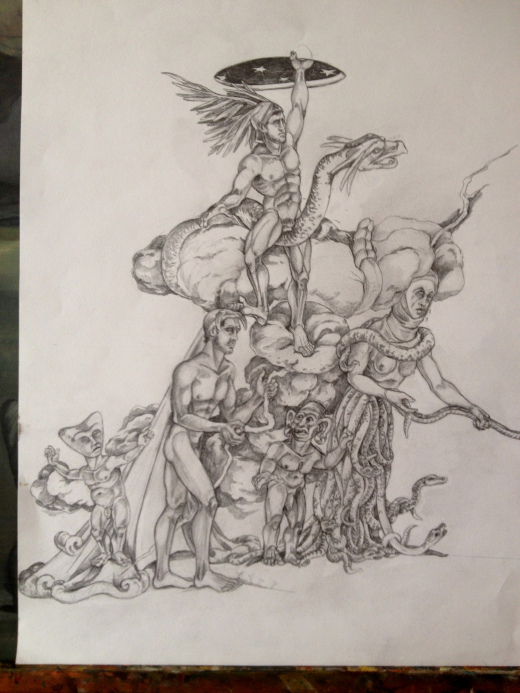
The painting is complex, an array of Old Gods toppling a sanctimonious New God. The following are character studies, graphite on paper.
Judas Iscariot
The Magdalene and her Scapegoat
a New Moon God
a Sun God, helmet now omitted
a host of Mesoamerican Old Gods
So that is it, busy at the task at hand. I have a few smaller paintings in various stages of completion, but this painting should take me through the summer when I begin the summer critique program at the Pennsylvania Academy of Fine Art- I cannot wait, just check out the cast room, the largest collection of first casts outside of Europe.
Heaven!
ONE wing of the cast collection at PAFA
So a new day, a new moon, a new painting, wish me luck.
Be well,
Lg
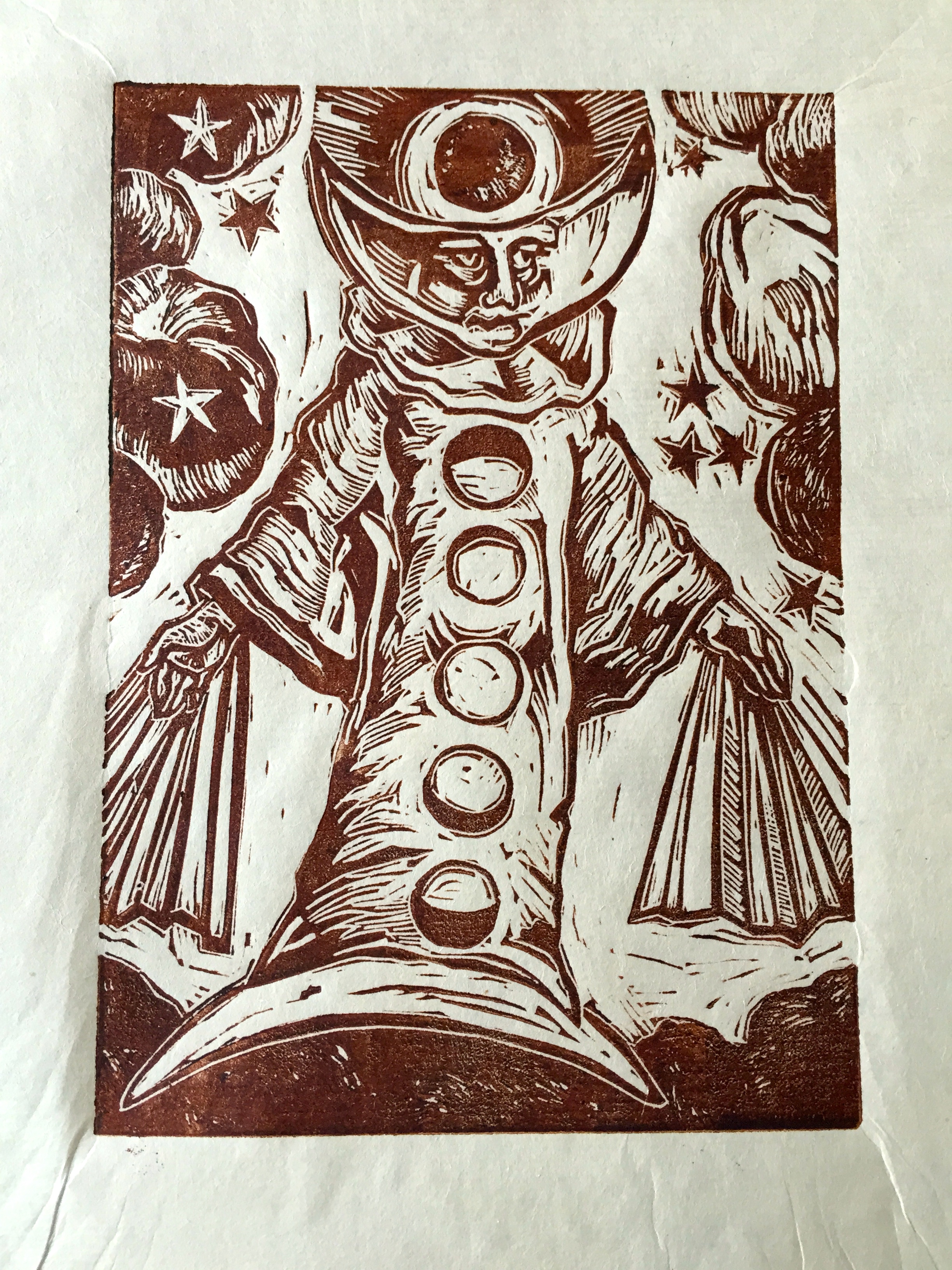
Tuesday the 20th of January is supposed to be a big deal, at least so I am told by my lunar minded friends. So to honor the occasion I’ve put together a new relief print, Mater eius Luna, The Mother of the Moon.
Mater eius Luna (The Mother of the Moon)
2015
relief print on rag paper
My desire was to capture the stages of the Moon in one image, that her stance is typically Marian is a happy accident.
I’m invited to a New Moon party this Tuesday, I’m bringing light by means of lunar inspired candles. The printed images awaiting to be glued upon the blank votives,thinking an even dozen.
Wishing all a happy New Moon, it also happens to be my mother’s birthday on the 20th, so happy birthday to Mater.
I’ve been struggling with the flu for well over a week, in spite of my first ever flu shot, I succumbed sometime during my recent trip back East. I find the flu to be a memento mori ( although it could be argued that everything is a memento mori to me). I wallowed lavishly in misery. But for the last few days I have been able to pull myself off the fainting couch and put the finishing touches on a painting I have been working on for the past few months, Persephone.
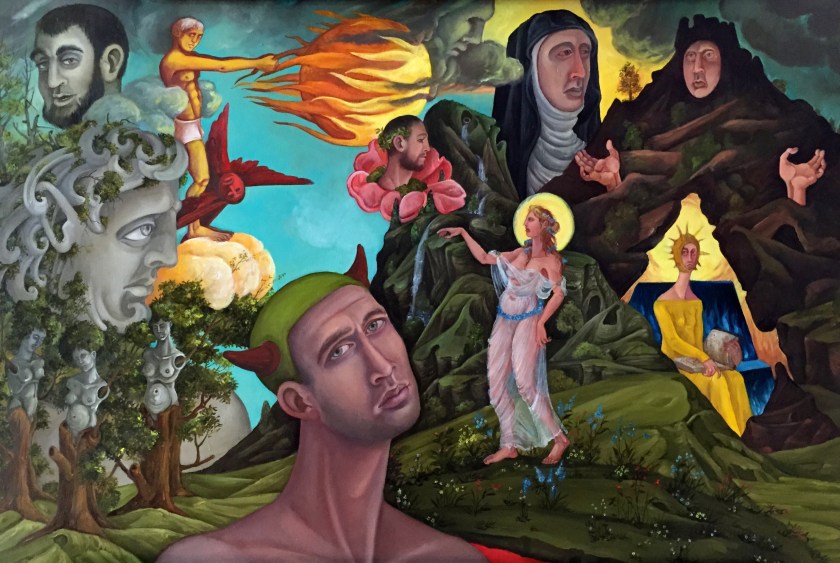
Persephone
2015
oil on canvas
24 by 36 inches
As is so often the case, my inspiration for the painting was yet another literature course, this time, World Mythology. We were focusing upon the Greeks, with a translation of the Homeric Hymns (c.600 B.C.E.) by Andrew Lang, link to text HERE. The opening passage was so beautiful, particularly as read by my professor, that I knew a painting was to be found amidst the flowery prose:
“Of fair-tressed Demeter, Demeter holy Goddess, I begin to sing: of her and her slim-ankled daughter whom Hades snatched away, the gift of wide-beholding Zeus, but Demeter knew it not, she that bears the Seasons, the giver of goodly crops. For her daughter was playing with the deep-bosomed maidens of Oceanus, and was gathering flowers—roses, and crocuses, and fair violets in the soft meadow, and lilies, and hyacinths, and the narcissus which the earth brought forth as a snare to the fair-faced maiden, by the counsel of Zeus and to pleasure the Lord with many guests. Wondrously bloomed the flower, a marvel for all to see, whether deathless gods or deathly men. From its root grew forth a hundred blossoms, and with its fragrant odour the wide heaven above and the whole earth laughed, and the salt wave of the sea. Then the maiden marvelled, and stretched forth both her hands to seize the fair plaything, but the wide-wayed earth gaped in the Nysian plain, and up rushed the Prince, the host of many guests, the many-named son of Cronos, with his immortal horses. Maugre her will he seized her, and drave her off weeping in his golden chariot, but she shrilled aloud, calling on Father Cronides, the highest of gods and the best.”
I was also inspired by the type of synoptic composition that the Roman’s excelled in, found often on sarcophagi relief carvings, and silver work; where the narrative just tumbles forth every which way, paying little heed to logical time sequence or proportion. I love the puzzle of guessing what the hell is going on . This detail from a Roman beaker (1-100 A.D.), recently on view at the Getty Villa in Malibu is typical of the sort of compositional puzzle I am speaking of.
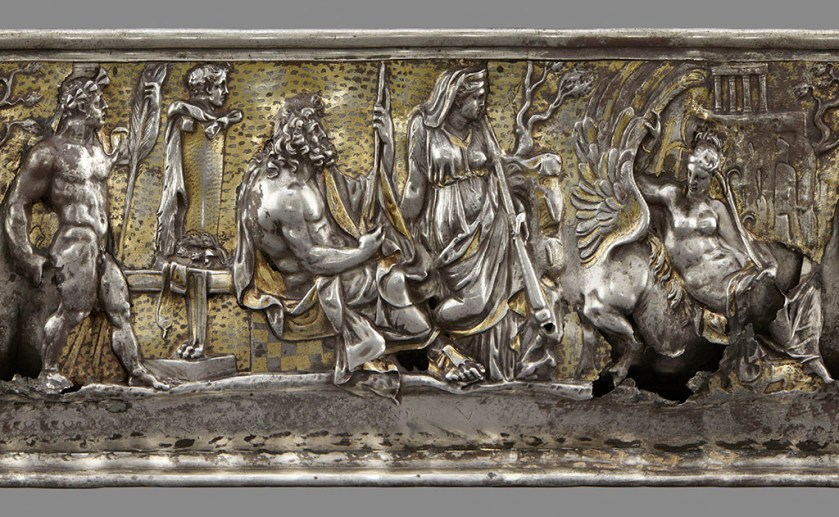
I set aside for myself the task to include as much of what I loved about the Hymn to Demeter into a relatively small canvas, playing upon the logic defying compositions of our dear Romans.
First off, there is “slim-ankled” Persephone , “deep bosomed, low slung hips”, such sexy play of words. Everytime I read the Greeks ( I just finished the Iliad) I am reminded of their absolute love of fleshiness. I wanted to capture that with Persephone.
detail of Persephone
A character I found curious was that of Hekate, she of the “shining head-tire”, who witnessed the soon-to-be abduction (once again, logical narrative sequence be damned); she and Phoebus Apollo are the only two to see what the hell went on , and the mad with terror Demeter turns to the “daughter of Persaeus”.
I love the passage of Hekate, serene and separate from the madness of lust, “thinking delicate thoughts”.
Hekate “thinking delicate thoughts”
Demeter, in her afore mentioned terror is described as having “tore the wimple about her ambrosial hair, and cast a dark veil about her shoulders”. I admire how that description alludes to her complete withdrawal from god and man and how in time, Mother Earth herself will suffer the consequence.
An interest of mine is how the Greeks, and later Blake , would anthropomorphize natural elements such as mountains, streams, clouds, turning them into sentient beings. I wanted to play with that as well. This mountain shudders as to what will come.
Another mountain harbors the “deep-bosomed” playmates of Persephone , who cowardly run off, abandoning our heroine.
The text describes how Hades, Lord with Many Guests ( yet no bride) seduces the “fair-faced maiden”. As Persephone gathers flowers, Hades seduces her with the floral mother load of all flowers, for there “wondrously bloomed the FLOWER, a marvel for all to see, wether deathless gods or deathly men”.
A handsome youth should sufficiently beguile dear Persephone.
Of “deathless gods”, many feature in this tale of sacrifice, redemption and rebirth, yet Prince Helios, the glorious Phoebus Apollo is always a delight to render.
As is the Father of Gods, the supreme Son of Kronus. Homer in the Iliad repeatedly reminds the reader how shifty this great god is , that only a fool would rely upon the Dark-browed god’s word. Persephone soon learns this harsh lesson when her cries for salvation fall upon her father’s deaf ears. He too busy collecting accolades from man:
” But he far off sat apart from the gods in his temple haunted by prayers, receiving goodly victims from mortal men”.
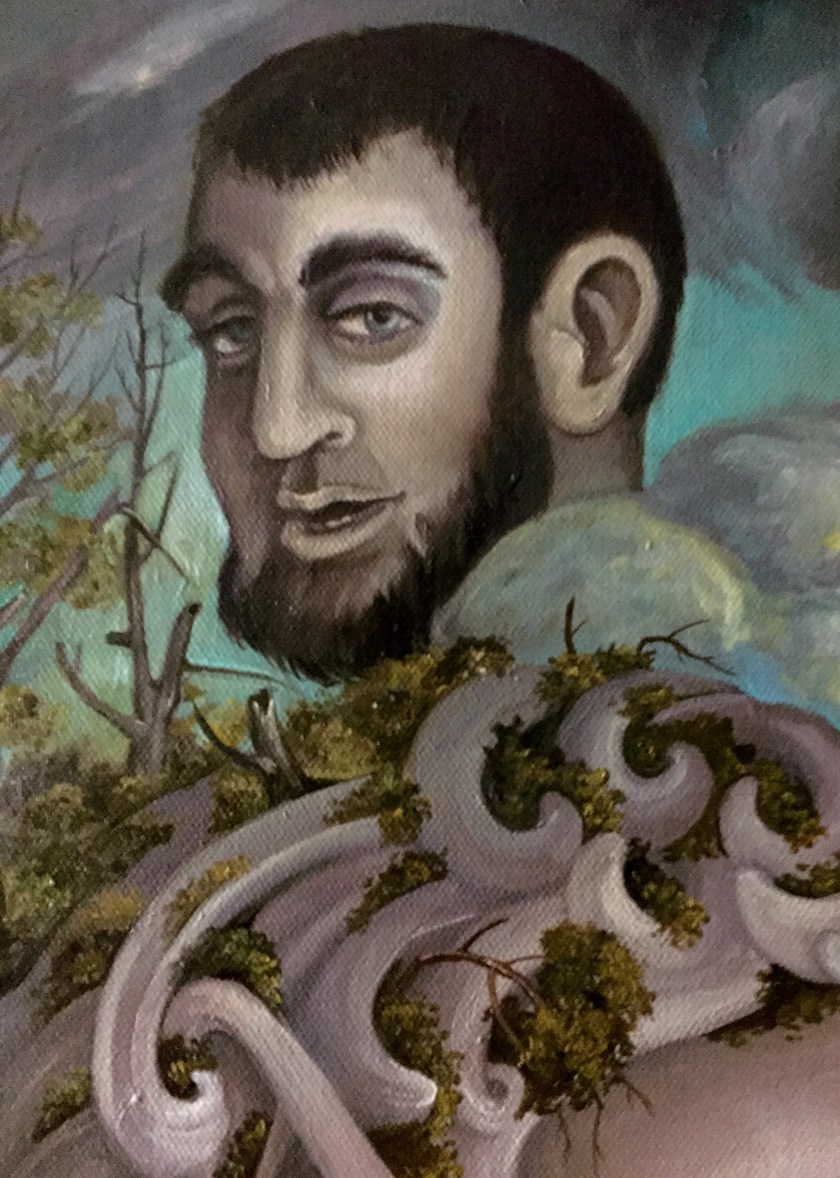
Frankly, Zeus just reminds me of any number of sexy, cocky Italian guys I have known in my day!
But I suppose in many ways this painting focuses not on Persephone but on Hades (first image). In some ways it turned out somehow “redeeming” the rape into an act of rectifying desperate loneliness. When the three great brothers were dividing the Universe, Hades certainly received the short straw. Zeus in his hubris received the heavens and earth, Poseidon the azure sea, but poor Hades, the dank Underworld-and without a bride. Apollo himself tells the bereaved Demeter, that although he shares her sorrow for her loss, she should see the sacrifice in a brighter light, that Hades is a god worthy of Her divine daughter:
“But, Goddess, do thou cease from thy long lamenting. It behoves not thee thus vainly to cherish anger unassuaged. No unseemly lord for thy daughter among the Immortals is Aidoneus, the lord of many, thine own brother and of one seed with thee, and for his honour he won, since when was made the threefold division, to be lord among those with whom he dwells.”
That may very well be posturing , defensive, patriarchal bullshit, but still, worth considering lonely Hades position.
But for now, I am finished with the Hymn to Demeter.
Be well, Lg
It seems fitting that today, on the Feast Day of Our Lady of Guadalupe, that the City of Angels should have the blessing of rain. It is a gloriously blustery day as I snugly make this post. Gracias.
As today is her feast day I wanted to make a print to honor the event , the vision of Our Lady by Juan Diego back on Dec. 12th 1531. There are countless images of the Virgen yet I felt emboldened to create my own. It was tempting to make yet another sweetly naive woodblock image of her, but I wanted my own image, one conceived from my own perspective as a white middle aged gay guy from the East Coast, not at all able to claim Latino heritage (although my husband is half Mexican) yet respectful and enamored by the culture.
So this is the result, in several color ways.
Nossa Senhora de Guadalupe
Dec. 2014
4 color relief print on paper
image size 8 by 10 inches, print 9 by 12
2 color relief print.
I think I like this approach the best and I will play with it some more. I like how Juan Diego’s guardian angel appears ethereal, more of an apparition.
Artist’s proof
My intention with this print was to implement the motifs that recur frequently within my work, namely the queer elements, in this case the Hero Twins as played by Juan Diego and his Aztec Guardian Angel. I loosely borrowed elements from the codices in creating the angel. There is a vague and historically inaccurate reference to a New Fire Ceremony in the background, a nod to the “pagan” past.
My intention was for it to appear as if the Old Gods were giving their blessings to the New.
Have a great feast! Thanking Tlaloc for the rain!
Lg
I understand the griping I hear so often about the social disconnect our society is enduring because of time spent online: cell phones ever in use narcissistically snapping “selfies”, the inane chatter, the mindless games. I’m the first to chime in when I see the abuses, but there is also a certain magic to it all. I have “met” from my often lonely studio some truly incredible people, folks I would most likely have never met, or had the confidence to introduce myself to.
This year has been a wonderful year in that I have actually met two “virtual” friends. Earlier this year I met my friend Carla who has been following my sites for some time. We were visiting beautiful Oregon and we had the chance to actually meet Carla and her husband Allen over dinner (best Italian food I have had in a very long time). One senses kinship from your computer screen but to have it confirmed in the flesh is a very special thing. My friendship with Carla would never have occurred without the internet pixies sprinkling camaraderie and goodwill.
Such was the case last evening as I was further blessed in having met another long time friend (who I had actually never heard speak) Andrew P.Wood ( his voice is lovely, he is southern boy after all). Andrew has always offered such kind support to my work; so often I feel I work in a vacuum , shouting at the winds,yet Andrew has consistently listened. Its all rather stunning as I hold him in such esteem, he is an incredibly gifted photo journalist, capturing in amber all that is beautiful, broken and left to be forgotten, namely the architecture and landscape of the rural American South. His images have struck me time and again for their intelligence and poetry , he expresses empathy for the material world that I share as well. He imbues fallen houses, decrepit storefronts and broken fencing with meanings that convey our own frailties ; memento moris others would rather pass by.
Last evening we actually met. Andrew with his equally convivial husband Greg were in LA on business and we arranged to have them for dinner last night. It was an absolutely wonderful evening , Andrew came bearing a very beautiful print (above) of one his memento moris , how fortunate is that? Having never actually met one another there could have been awkwardness but there was not, instead there was the kinship that I had suspected from our brief exchanges.
There is magic out there, and its online.
I feel fortunate indeed.
Lg
Post Script: speaking of “selfies”, which are never kind to me, Andrew snapped one of us as I was fussing with dinner.
I’ve been reading a fair amount of poetry later, mostly for class, but also revisiting some old favorites; one being Christina Rossetti’s pre-Raphaelite jewel, Goblin Market (Link Here).
This little graphite drawing was inspired by her wonderfully dark poem.
2014
graphite on paper
8.5 by 11 inches
“Morning and evening
Maids heard the goblins cry:
Come buy our orchard fruits,
Come buy, come buy”